


Disclaimer: machine translated by DeepL which may contain errors.

Why Can Aquatic Plants Survive Underwater?
Hiroyuki Koga
(Associate Professor, Department of Biological Sciences)
Aquatic plants, swaying gracefully in the water, are beloved as companions to ornamental fish or as the stars of aquariums where the plants themselves are the main attraction. These aquatic plants are, in fact, members of the land plant family.Land plants originated from algae that originally lived in water and moved onto land more than 450 million years ago. In the process, they acquired mechanisms to adapt to the terrestrial environment and have since diversified into more than 400,000 species.Aquatic plants refer to those terrestrial plants that have readapted to environments near or within water. To put it in animal terms, think of dolphins or sea turtles—this makes the concept easier to understand.
For plants, water and light are essential for survival. Water’s edge areas are rich in water and have few obstacles to block light, making them seem ideal for plants.In fact, plants that have re-entered aquatic environments can be found in different phyla—including bryophytes, ferns, and seed plants—suggesting that such adaptations occurred independently on multiple occasions. However, the aquatic environment is not all positive. The biggest problem is that the plant body sinks in water.Underwater, it becomes difficult to obtain both the oxygen needed for respiration and the carbon dioxide needed for photosynthesis. Consequently, while ordinary terrestrial plants can tolerate submersion for short periods, they cannot grow if submerged for several days to several weeks and eventually wither and die.Furthermore, if there is a current, strong forces are exerted on the leaves and branches, which can cause them to become damaged or break.Aquatic plants are those that have overcome these conditions and adapted to the aquatic environment. There are various ways they have adapted, including emergent plants and floating-leaved plants that keep their leaves above the water; semi-aquatic plants that grow on land during dry periods but can also grow underwater when the water level rises; and submerged plants that are specialized for living entirely underwater.
Among aquatic plants, submerged plants and semi-aquatic plants are particularly interesting because they can grow healthily even when their entire bodies are submerged.Why are they able to live underwater, where survival would normally be difficult? One key factor is believed to be the shape of their leaves. Submerged plants and emergent plants that grow underwater produce slender, thin leaves. In some species, the leaves are finely branched.Since this shape is common to many aquatic plants from different lineages, it is thought to offer some advantage for life underwater. For example, by increasing surface area or reducing internal tissues that are not heavily involved in material exchange with the outside environment, these plants may be able to efficiently utilize the limited oxygen and carbon dioxide available in the water. However, these explanations have not yet been fully confirmed.Other factors, such as microstructures like cell walls and physiological properties, also play a role in survival underwater. Consequently, it remains unclear to what extent leaf shape is crucial for survival in water. Furthermore, the evolutionary mechanisms by which such leaf shapes were acquired are not yet understood.
To unravel this mystery, it is necessary to use aquatic plants suitable for research and to delve deeply into the mechanisms of form development and physiological characteristics at the genetic level.We have established the aquatic-terrestrial plant *Mizuhakobe* (a member of the Plantaginaceae family) and its close relatives as new model organisms for aquatic plant research, and we are particularly focused on elucidating the evolutionary mechanisms underlying their morphogenesis. Through this new research material, we aim to unravel the mysteries of aquatic plants that remain unknown to everyone.
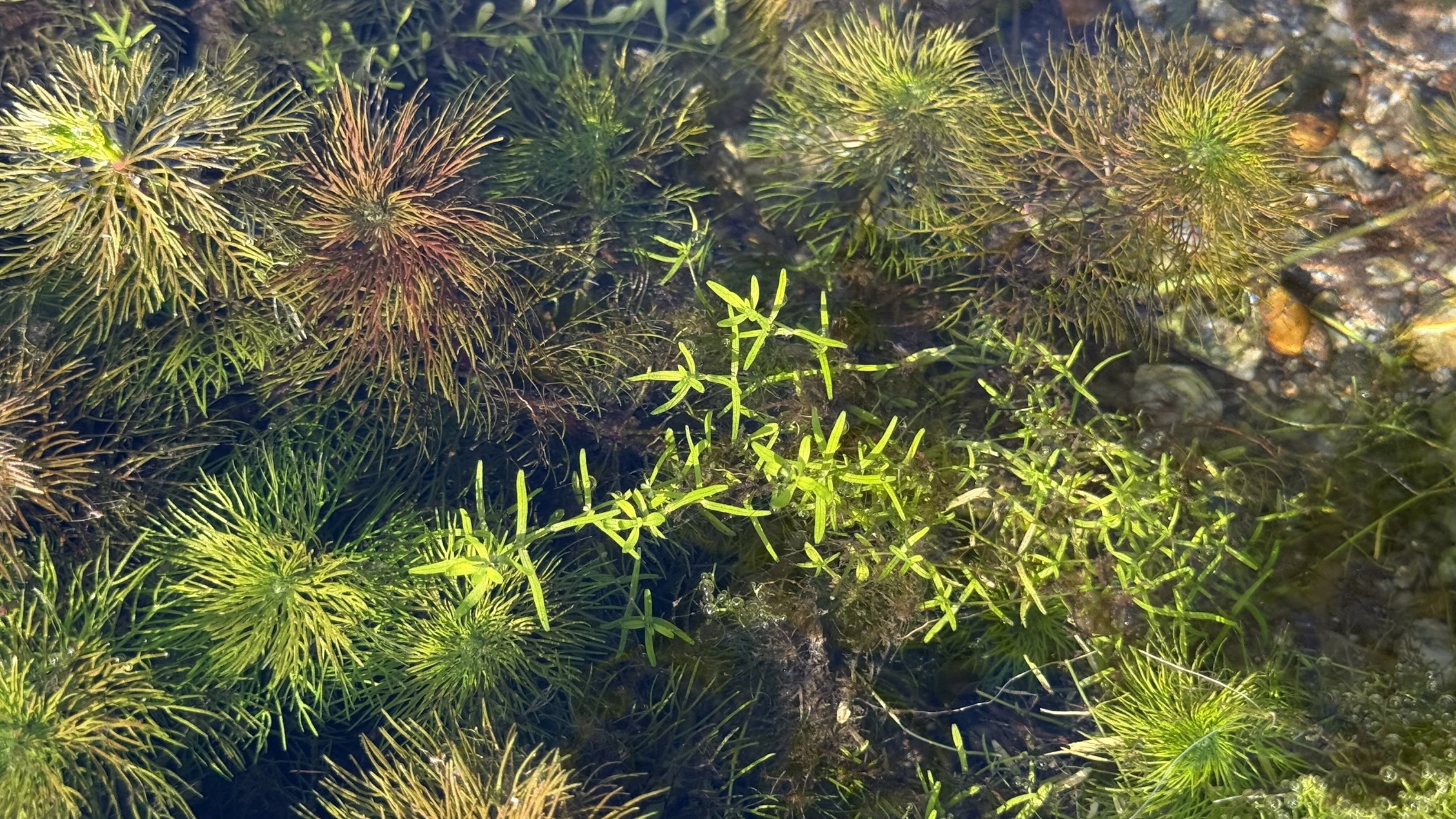 (In a river teeming with aquatic plants, Mizuhakobe (center) bears slender leaves underwater, while Kikumo (left and above)—also an amphibious plant—has finely branched leaves.)