


DATE2026.10.09 #Press Releases
First Demonstration of Optical Detection of Electron Spins in a Metal–Organic Framework (MOF)
—An Important Step Toward Highly Sensitive Chemical Quantum Sensing—
Points
- For the first time, researchers have demonstrated the optical detection of electron spins of a photo-excited triplet state(1) generated in a MOF(2).
- Future work is expected to achieve highly sensitive quantum sensing(3) through the integration of MOFs and optical detection.
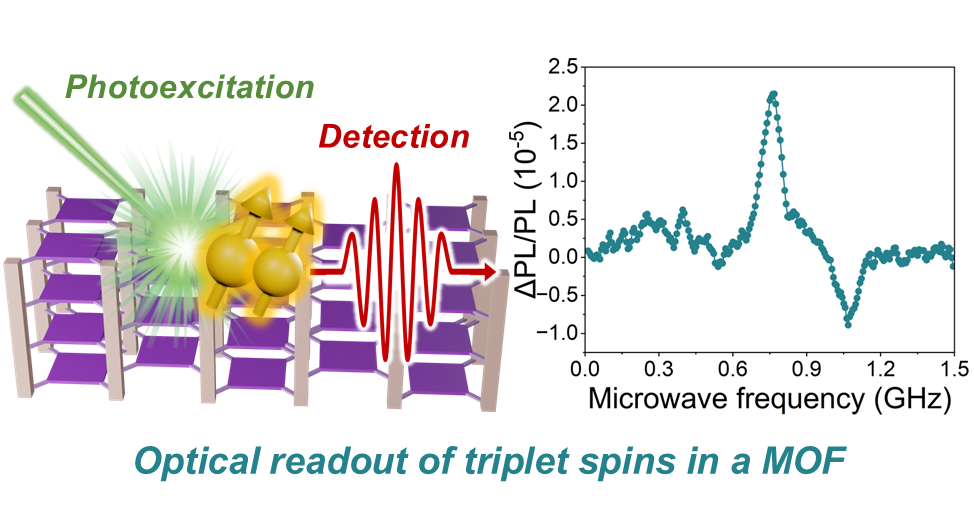
Optical readout of triplet spins in a MOF
Abstract
A research group led by graduate students Miku Inoue and Wataru Ishii and Professor Nobuhiro Yanai at the Graduate School of Science, The University of Tokyo, in collaboration with Postdoctoral Researcher Alistair Inglis and Reader Sam L. Bayliss of University of Glasgow; Thomas W. Bradbury, a Ph.D. student, and Professor Jenny Clark at the University of Sheffield; Assistant Professor Hiroki Nagashima and Associate Professor Kiminori Maeda at Saitama University; Dr. Yoshitaka Aoyama and Dr. Yusuke Nishiyama of JEOL Ltd.; Senior Researcher Mizuho Asada and Team Leader Toshikazu Nakamura from the Institute for Molecular Science; and Professor Yasuhiro Kobori of Kobe University, have, for the first time, demonstrated the optical detection of electron spins in MOFs using optical detection magnetic resonance measurements.
Optically detected magnetic resonance (ODMR)(4) has attracted attention as a useful method for reading out spin qubits in quantum sensing. In this study, the research team synthesized a metal–organic framework (MOF) utilizing a porphyrin derivative(5) as a ligand, and successfully achieved the first optical detection of photo-excited triplet spins generated by photoexcitation. Although MOFs have been viewed as promising materials for quantum sensing, the optical detection of spins, which is a key requirement for realizing quantum sensing, had not previously been achieved within a MOF. This study represents an important step toward highly sensitive chemical quantum sensing combining MOFs and ODMR.
Content
Optically addressable spins are suitable for quantum sensing and have been intensively studied in recent years, as they can be detected with higher sensitivity and spatial resolution compared to electron spin resonance (ESR)(6), which relies on microwave detection. Nitrogen-vacancy (NV) centers in diamond are benchmark materials for such systems; however, because they rely on intrinsic crystal defects, they are constrained by limited structural tunability and weak coupling with external analytes. Conversely, molecular spins provide excellent controllability, allowing precise tailoring of spin characteristics through molecular design. MOFs enable precise spatial control over the arrangement and orientation of electron spins in their ligands. In addition, their porous nature allows analytes to be adsorbed inside the pores, facilitating close-range interactions with the spins in the MOFs. Although MOFs have been regarded as promising platforms for quantum sensing due to these features, the optical detection of electron spins generated within a MOF has not been demonstrated.
In this study, the research team synthesized a MOF utilizing free-base porphyrin ligands, which are known to generate photo-excited triplet states. The dynamics and spin properties of the triplets were evaluated using time-resolved photoluminescence (TRPL)(7) and ESR measurements. Furthermore, the optical detection of photo-excited triplet spins was successfully demonstrated for the first time.
The crystal structure of the synthesized MOF was confirmed by micro electron diffraction(8) (Fig. 1a). In previous report on the same MOF, the crystal structure was solved via simulations based on powder X-ray diffraction data. The electron diffraction measurements of this study yielded a structure consistent with the previous report and additionally confirmed that the free-base structure of the porphyrin was preserved within the MOF.
To investigate the exciton dynamics within the MOF, TRPL measurements were conducted, revealing two emission components (Figure 1b). Based on their emission timescales, these components were assigned to fluorescence and phosphorescence, respectively. In addition, the team evaluated whether triplet hopping occurred within the MOF. When excitons undergo hopping, triplet–triplet annihilation (TTA)(9) occurs. Since TTA depends on the excitation laser power, the laser power dependence of the second component was evaluated. As a result, no significant laser power dependence was observed. This result suggests that TTA does not occur within the MOF and that triplet hopping is suppressed.
Furthermore, ESR measurements were conducted to evaluate the spin properties (Figure 1c). The spectrum of transient ESR measurement shows the photo-excited triplet state, and simulation enabled the calculation of parameters related to the zero-field splitting of the triplet state. In addition, pulsed ESR measurements successfully detected signals from the photo-excited triplet state. The spin–spin relaxation time (T2)(10) was varied between 0.78 μs and several microseconds depending on the laser power intensity (Figure 1d, e). These results demonstrate that the photo-excited triplet spins in the MOF maintain quantum coherence long enough for potential applications in quantum sensing.
Finally, research team conducted ODMR measurements. When the microwave frequency was swept at zero magnetic field while monitoring changes in emission intensity from the MOF, emission intensity changes were observed at specific frequencies (Figure 2b). This indicates that spin sublevel transitions were induced by microwave irradiation at frequencies matching the zero-field splitting of the excited triplet state. The measured zero-field splitting parameters were in excellent agreement with those determined from the ESR measurements. Furthermore, ultrafast spectroscopy and wavelength-dependent ODMR measurements suggested a mechanism in which the phosphorescence intensity is primarily modulated by microwave irradiation (Figure 2c). These results prove the optical readout of the excited triplet spins generated within the MOF.
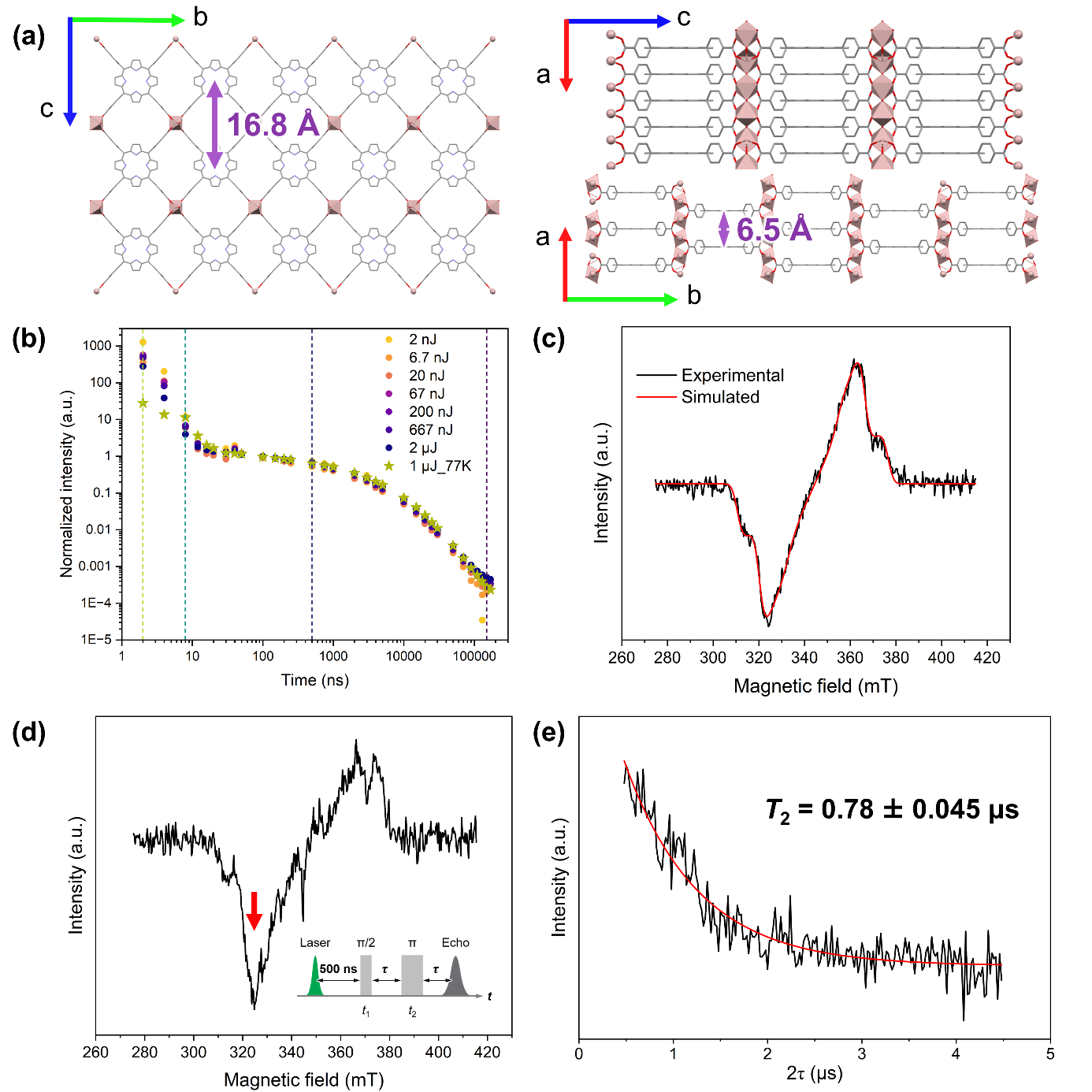 Fig. 1: (a) Crystal structure of the free-base porphyrin MOF used in this study. (b) Photoluminescence decay at 720 nm obtained from TRPL measurements. (c) ESR spectrum of the photo-excited triplet state obtained from transient ESR measurement. (d) ESR spectrum of the photo-excited triplet state obtained from pulsed ESR measurements. Inset: Pulse sequence used for the measurement. (e) Decay of the triplet signal at 324.8 mT and the spin–spin relaxation time (T2) obtained from the fitting curve.
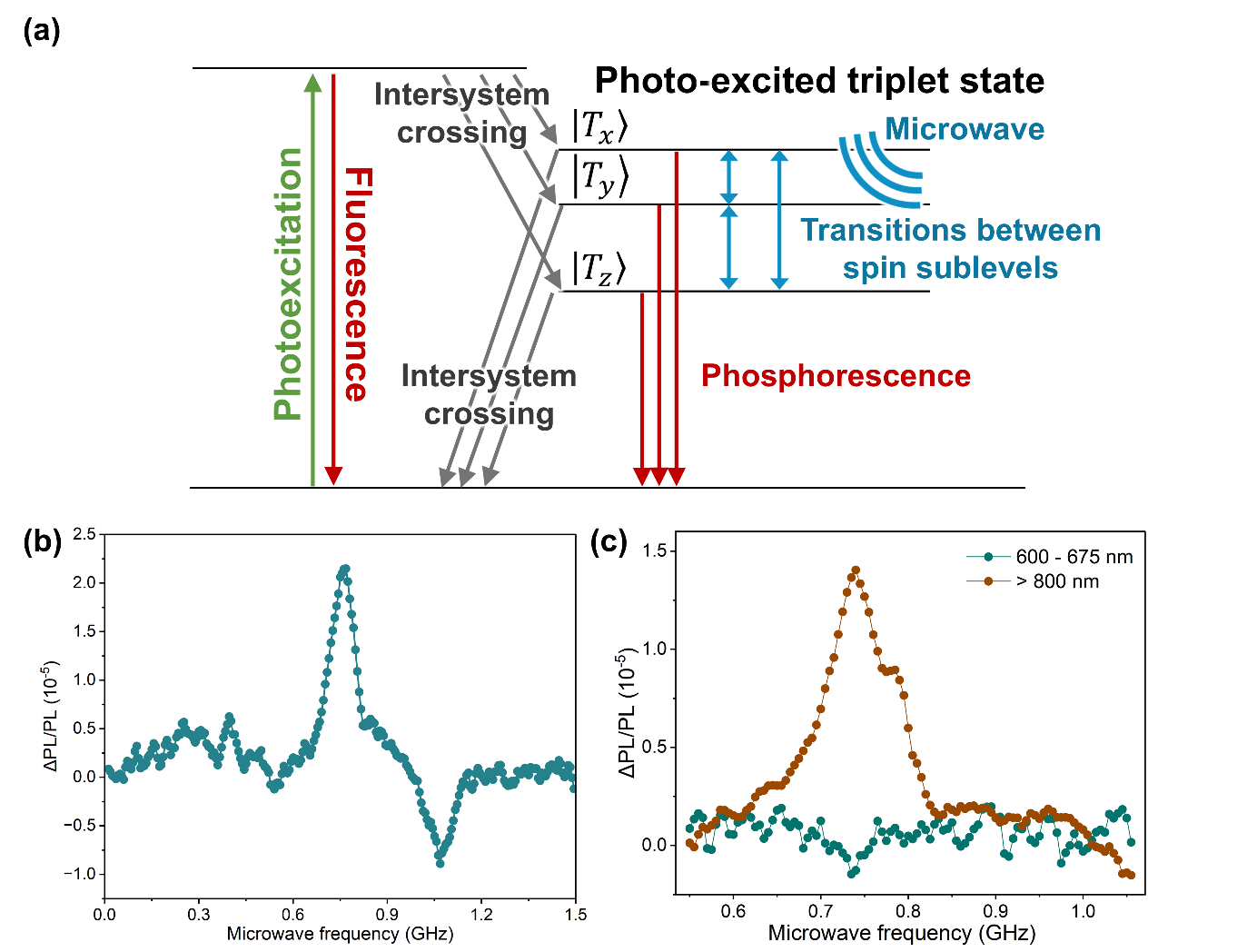 Fig. 2: (a) Mechanism of ODMR measurements using excited triplet states. Populations among the three levels of the excited triplet state become imbalanced due to spin-selective intersystem crossing. Irradiation with microwaves at frequencies corresponding to the energy splittings between the triplet sublevels alters the populations, which is read out as changes in fluorescence or phosphorescence intensity. (b) Zero-field ODMR spectrum of the porphyrin MOF. (c) Zero-field CW-ODMR spectra with PL collected at only shorter or longer wavelength.
This study successfully demonstrates the optical detection of electron spins within a MOF. Because MOFs are highly customizable materials, this demonstration is expected to pave the way for exploring diverse systems and lead to the construction of a comprehensive library of quantum sensors. Furthermore, by utilizing the response patterns of this library toward specific chemical substances, the realization of highly sensitive quantum sensing of targeted analytes is anticipated.
Information
The University of Tokyo
Department of Chemistry, Graduate School of Science
Miku Inoue
Wataru Ishii
Prof. Nobuhiro Yanai
University of Glasgow
James Watt School of Engineering
Dr. Alistair Inglis
Dr. Sam L. Bayliss
University of Sheffield
School of Mathematical and Physical Sciences
Thomas W. Bradbury
Prof. Jenny Clark
Saitama University
Graduate School of Science and Engineering
Dr. Hiroki Nagashima
Prof. Kiminori Maeda
JEOL Ltd.
Dr. Yoshitaka Aoyama
Dr. Yusuke Nishiyama
Kobe University
Center for Life Photonic Innovation
Prof. Yasuhiro Kobori
Institute for Molecular Science
Instrument Center
Dr. Mizue Asada
Dr. Toshikazu Nakamura
Paper information
-
Journal Name Journal of the American Chemical Society Paper Title Optically Addressable Spins in a Metal–Organic FrameworkAuthors Miko Inoue, Wataru Ishii, Thomas W. Bradbury, Hiroki Nagashima, Alistair Inglis, Yoshitaka Aoyama, Yusuke Nishiyama, Mizue Asada, Toshikazu Nakamura, Kiminori Maeda, Yasuhiro Kobori, Jenny Clark*, Sam L. Bayliss*, Nobuhiro Yangai* DOI 10.1021/jacs.6c12867
Acknowledgements
This work was partly supported by the JST-CREST Program (JPMJCR23I6) (N.Y.), JST-ASPIRE Program (JPMJAP2423) (N.Y.), JSPS KAKENHI (JP23H00304 (N.Y.), JP26H00377 (N.Y.), JP25KJ0746 (W.I.), JP25KJ0747 (M.I.), JP23K17662 (K.M.)), JST-PRESTO (JPMJPR24F7) (H.N.), and MEXT Quan-tum Leap Flagship Program (MEXT Q-LEAP) (JPMXS0120206207) (K.M.). A.I., S.L.B., J.C., and T.W.B acknowledge support from UK Research and Innovation [grant numbers MR/W006928/1, EP/T012455/1, EP/L022613/1, UKRI2572 and CASE studentship 2888858].
Glossary
Note 1: Photo-excited triplet state
An excited state in a light-absorbing molecule in which the spins of two electrons are aligned parallel. The electron spins of an excited triplet state have potential for qubits. Even in zero magnetic field, the excited triplet state possesses three distinct sublevels with slightly different energies, and electron spins preferentially occupy specific sublevels. ↑
Note 2: Metal–organic frameworks(MOFs)
Crystalline polymers formed by the coordination bonding of metal ions and organic ligands. Various crystal structures can be tailored by altering the metal ions and ligands. As porous materials, they can adsorb other molecules within their internal pores. While extensively studied in the fields of gas adsorption and catalysis, they have recently attracted significant attention in quantum chemistry. ↑
Note 3: Quantum sensing
A sensing methodology that utilizes quantum phenomena, such as quantum superposition and entanglement. Because superposition and entangled states are highly sensitive to external environment, quantum sensing is expected to enable higher-sensitivity detection compared to conventional techniques. Since electron spins can function as qubits, quantum sensing can be realized using organic molecules or MOFs incorporating them as ligands. ↑
Note 4: Optically detected magnetic resonance(ODMR)
A technique to detect electron spins using light. It detects changes in luminescence or absorption intensity resulting from spin-state changes upon microwave irradiation of electron spins. Leveraging high-energy light affords both high detection sensitivity and spatial resolution. ↑
Note 5: Porphyrin Derivatives
Porphyrins are the basic skeletal structures of substances that play important roles in living organisms. In this study, molecules possessing a free-base porphyrin skeleton—without a metal ion coordinated at the center—are used as ligands in MOFs. ↑
Note 6: Electron spin resonance(ESR)
A measurement technique utilizing the resonance phenomenon when microwaves are irradiated onto electron spins split in energy by an external magnetic field. For excited triplet spins, the zero-field splitting of energy levels can be calculated from an ESR spectrum. Furthermore, pulsed ESR measurements, which apply microwaves for extremely short durations, allow the evaluation of spin dynamics, including relaxation times. ↑
Note 7: Time-resolved photoluminescence(TRPL)
A technique that measures the time-dependent change in luminescence intensity after photoexcitation with extremely short laser pulses. It provides insights into the dynamics of excited states. ↑
Note 8: Electron diffraction
A technique for investigating crystal structures by irradiating samples with an electron beam using a transmission electron microscope (TEM). It allows measurements even on samples with relatively small crystal sizes. ↑
Note 9: Triplet-triplet annihilation(TTA)
An energy transfer phenomenon that occurs when two excited triplet states collide. Energy is transferred to one molecule, while the other returns to the ground state. The collision probability depends on the excitation light intensity. ↑
Note 10: Spin–Spin Relaxation Time(T2)
The time required for the spin component perpendicular to the external magnetic field, which is generated by an ultra-short microwave pulse, to reach a completely random state through energy exchange between spins. In qubits using electron spins, this time corresponds to the coherence time of the quantum superposition state. ↑