


DATE2026.08.18 #Press Releases
Rethinking Birth and Bipedalism
Disclaimer: machine translated by DeepL which may contain errors.
— Neanderthal Pelvises Challenge Long-Standing Evolutionary Theory —
Summary
Dr. Christoph Zolikofer and Dr. Marcia Ponce de León of University of Zurich, Switzerland; Dr. Michael Walker of Murcian Association for the Study of Palaeoanthropology and the Quaternary, Murcia, Spain, and Associate Professor Osamu Kondo of the Department of Biological Sciences, Graduate School of Science, The University of Tokyo, have used computer modeling to reconstruct a nearly complete Neanderthal pelvises excavated from Sima de las Palomas (Spain), and Dederiyeh Cave (Syria), and identified differences between Neanderthals and modern humans regarding the internal structure of the pelvis related to childbirth and the external structure related to locomotion. This finding has the potential to overturn the “obstetric dilemma” hypothesis, a long-standing theory regarding the evolution of the human pelvis.
For decades, the “obstetric dilemma” hypothesis has been the standard explanation for human pelvic shape. This hypothesis posits that human pelvic shape represents a trade-off between the need to give birth to infants with large brains and the need to walk efficiently on two legs.
This study demonstrated that, while the internal pelvic structures related to childbirth are similar between Neanderthals and modern humans, the external structures related to locomotion differ distinctly between the two groups, beginning as early as infancy—before the onset of walking. This suggests that walking efficiency was not the primary factor limiting the birth canal, and that the true trade-off may lie between childbirth and pelvic floor stability.
Based on this research, a more complex “multifactorial pelvis” model—in which stability, locomotion, and childbirth all contribute to pelvic formation—has been proposed as a hypothesis regarding human pelvic evolution, moving beyond the simple “childbirth vs. walking” narrative.
The research findings were published on August 17, 2026, in the international academic journal *Proceedings of the National Academy of Sciences (PNAS)*.
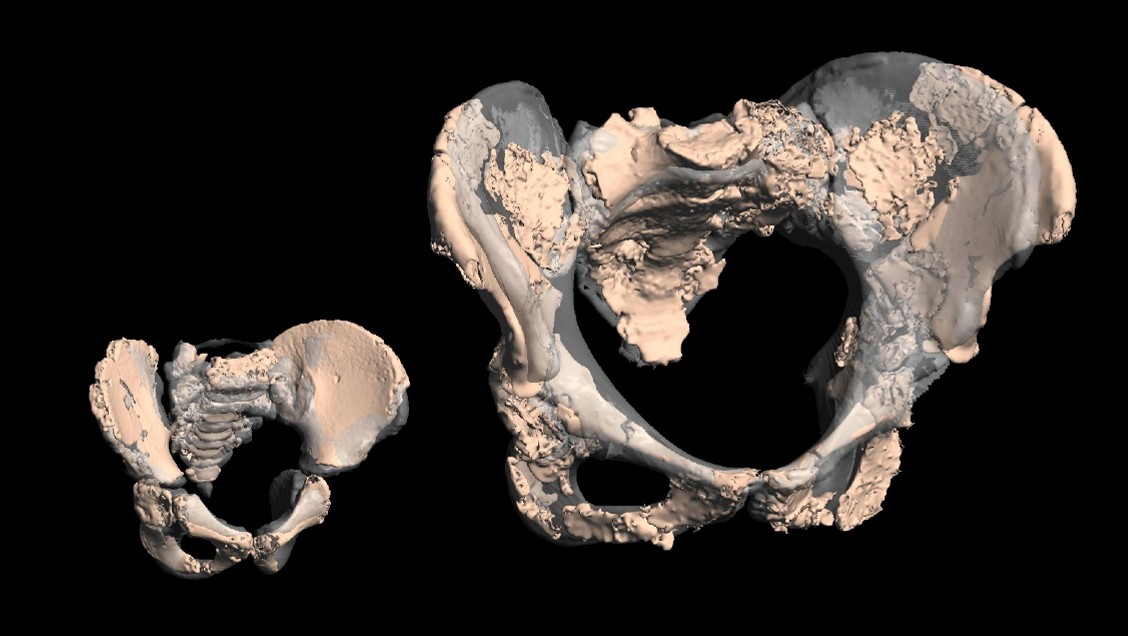 Virtual reconstructions of the Neanderthal pelvises of a 1.5-year-old infant from Dederiyeh Cave, Syria (left), and a young adult female from Sima de las Palomas de Cabezo Gordo, Spain (right). Age- and sex-matched modern human pelvises are superimposed in transparency to highlight form differences. Image credit: Marcia Ponce de León and Christoph Zollikofer (University of Zurich)
Journals
| Journal Title | Proceedings of the National Academy of Sciences (PNAS) |
|---|---|
| Paper Title |