


DATE2026.07.13 #Press Releases
Device Design for Ultra-High-Speed Quantum Memory Operation
Disclaimer: machine translated by DeepL which may contain errors.
—Toward High-Efficiency Magnetic Data Writing That Does Not Rely on Heat—
Summary
Takumi Matsuo, a graduate student at the Graduate School of Science, The University of Tokyo (at the time of the research), Tomoya Higo, Project Associate Professor (at the time of the research) (currently Associate Professor, Faculty of Science and Technology, Keio University), Professor Satoru Nakatsuji, and others, have demonstrated that in antiferromagnets—materials expected to serve as magnetic recording layers for next-generation ultra-high-speed, low-power logic and memory devices—the electrical switching mechanism of the magnetic state via spin-orbit torque (SOT) . In particular, they demonstrated that by efficiently dissipating the generated heat, a switching mechanism can be achieved that does not rely on Joule heating but instead utilizes the intrinsic high-speed magnetic dynamics of the antiferromagnet on the picosecond (one trillionth of a second) scale.
In this study, we investigated how the magnetic recording characteristics due to SOT vary with the film thickness of Mn₃Sn thin-film devices.The results revealed that by reducing the film thickness to suppress the effects of heat generation, the magnetic switching mechanism transitions from a which is governed by heat generation and cooling processes—to an, in which the spin current directly controls the antiferromagnetic order.Since writing via the endogenous mechanism allows for the utilization of the high-speed magnetic dynamics of antiferromagnets, it is expected to enable memory operation with shorter current pulses than the temperature-assisted mechanism and to result in significant energy savings.These findings lay an important foundation for the realization of new non-volatile memory technologies that utilize the ultrafast magnetic dynamics of antiferromagnets.
These research findings were published online in the international scientific journal *Nature Communications* on July 13, 2026.
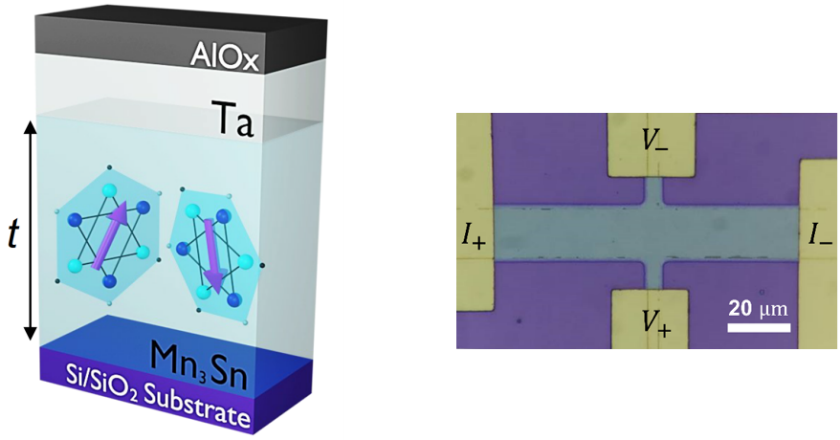
Figure 1: (Left) The antiferromagnetic Mn₃Sn/ heavy metal Ta multilayer film used in the study. Alumina (AlO_x) serves as the cap layer. t represents the thickness of the Mn₃Sn layer. (Right) Microscopic image of a Mn₃Sn/Ta multilayer switching device. I+ and I- are current terminals; V+ and V- are voltage terminals.
Journals
-
Journal Name Nature Communications Paper Title Crossover between intrinsic and temperature-assisted regimes in spin-orbit torque switching of antiferromagnetic orderAuthors Takumi Matsuo†, Tomoya Higo†,*, Daisuke Nishio-Hamane, Takuya Matsuda, Ryota Uesugi, Hanshen Tsai, Kouta Kondou, Shinji Miwa, Yoshichika Otani, Satoru Nakatsuji*(†: Co-first authors, *: Corresponding author) DOI 10.1038/s41467-026-74311-6