


DATE2026.06.30 #Press Releases
Stopping Hydrogenation at Just the Right Point
ーSingle-atom platinum catalyst enables highly selective and continuous synthesis of nitrones, valuable intermediates for pharmaceutical-related moleculesー
Key Points
- The research team developed a single-atom platinum catalyst, in which platinum atoms are individually immobilized on a carbon material, and succeeded in the highly selective synthesis of nitrones from nitro compounds and aldehydes.
- Whereas conventional platinum nanoparticle catalysts often cause over-reduction of the nitrone product, the new catalyst suppresses this undesired reaction and allows the process to stop at the desired nitrone stage.
- This method uses readily available starting materials and hydrogen, generating mainly water as a byproduct. It is expected to contribute to more sustainable manufacturing processes for pharmaceuticals, agrochemicals, and functional chemicals.

Selective hydrogenation using a single-atom platinum catalyst
Overview
A research group led by Project Assistant Professor Tomohiro Yasukawa of the Graduate School of Science, The University of Tokyo (at the time of the study, currently Lecturer at Monash University) and Professor, Project and Emeritus Shū Kobayashi of Presidential Endowed Chair for “Green Material Conversion”, The University of Tokyo, has developed a new reaction that enables the highly selective synthesis of nitrones from nitro compounds and aldehydes using a single-atom platinum catalyst(Note1) , in which individual platinum atoms are immobilized on a carbon material.
Nitrones (Note2) are useful compounds with diverse applications. However, conventional synthetic methods often require expensive and unstable intermediates and can generate large amounts of waste. In the reaction developed in this study, nitrones can be synthesized in a single operation from readily available and relatively stable nitro compounds and aldehydes using hydrogen, a clean reductant that mainly produces water after the reaction. While conventional platinum nanoparticle catalysts(Note3) tend to promote over-hydrogenation, the key feature of the present catalyst is that it can stop the reaction at the nitrone stage.
This achievement provides a new method for producing nitrones, which are useful in the synthesis of pharmaceuticals, agrochemicals, and functional chemicals, in a more efficient and environmentally benign manner. The study also demonstrates that single-atom catalysts are not merely a way to reduce the use of precious metals but can function as precisely designed reaction fields that control the selectivity of complex organic reactions.
Detail of the Research
Background
Hydrogen is a clean reductant that mainly produces water as a byproduct after reaction, and it plays an important role in sustainable chemical synthesis. However, in reactions using hydrogen, it is often difficult to precisely control “how far” the reduction proceeds. This is particularly difficult in cascade reactions (Note4) , where multiple reaction steps occur sequentially. To stop the reaction at the desired intermediate stage, sophisticated catalyst design is therefore essential.
Nitrones are used and studied as radical-trapping reagents, antioxidants, and enzyme inhibitors, and they are also important synthetic intermediates for constructing complex nitrogen-containing compounds. However, conventional nitrone syntheses generally require the prior preparation of hydroxylamines(Note5) , which are often unstable and difficult to store. These methods therefore suffer from increased synthetic steps and the generation of large amounts of waste.
An ideal approach would be a “cascade hydrogenative coupling reaction,” in which readily available and relatively stable nitro compounds and aldehydes are reacted in the same vessel, while hydrogen gas gradually reduces the nitro compound and assembles the target molecule in a single operation. In this process, the nitro compound must be selectively reduced to a hydroxylamine, which then reacts with an aldehyde. However, the hydroxylamine, the aldehyde, and the nitrone product can all undergo further reduction, making it difficult to obtain only the desired nitrone selectively (Figure 1). Conventional platinum nanoparticle catalysts have many different types of reactive sites on their surfaces, making it difficult to fully suppress over-reduction. Therefore, a more precisely designed catalyst was required.
 Figure 1. Reaction pathway and side reactions in cascade hydrogenative coupling
Research Findings
In this study, the research team designed and prepared a single-atom platinum catalyst in which platinum atoms are isolated and immobilized on a carbon material containing nitrogen and phosphorus. Electron microscopy observations (Figure 2), X-ray absorption spectroscopy, X-ray photoelectron spectroscopy, and related analyses confirmed that platinum was present mainly in a single-atom state and was stabilized by the nitrogen- and phosphorus-containing carbon support.
When this catalyst was used, further hydrogenation of the nitrone product was strongly suppressed, in sharp contrast to conventional platinum nanoparticle catalysts, and the desired nitrone was obtained with high selectivity. Reaction analysis showed that aldehydes and nitrones are difficult to hydrogenate on the single-atom platinum catalyst. Furthermore, deuterium-labeling experiments and DFT calculations (Note6) suggested that water-assisted cleavage of the hydrogen molecule is important for the reaction, and that introducing phosphorus adjusts the electronic state of platinum and promotes hydrogen activation.
 Figure 2. Electron microscopy observation of the single-atom platinum catalyst (Bright spots indicate platinum atoms.)
The method was applicable to a wide range of substrates, enabling the synthesis of 40 different nitrones, including aromatic, heteroaromatic, and aliphatic examples. In particular, nitrones could be obtained while preserving functional groups that are usually reactive under hydrogenation conditions, such as carbon–carbon double bonds, carbonyl groups, and aryl halides. The method was also applied to the synthesis of intermediates related to the antitumor antibiotic FR900482, the cholesterol absorption inhibitor ezetimibe, and the natural product hydroxycotinine.
In addition, the team extended the reaction to a continuous-flow system (Note7) , in which the catalyst was packed into a column and the starting-material solution was continuously passed through it. Using this system, nitrones were continuously produced over 48 hours (Figure 3).
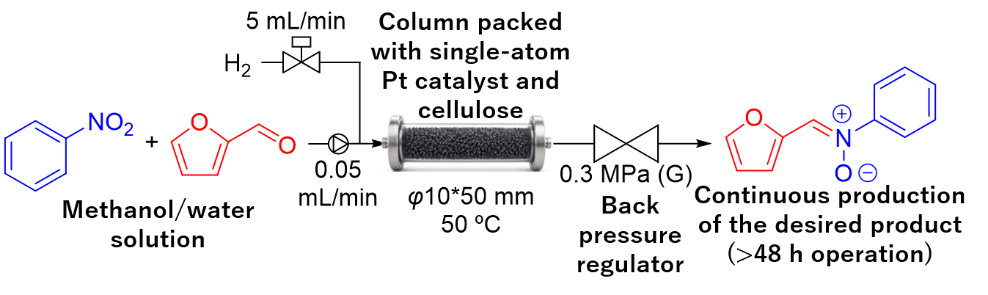 Figure 3. Single-atom platinum catalyst and continuous-flow synthesis
Future Prospects
This work shows that single-atom catalysts are not only useful for reducing the amount of precious metal required but can also serve as “precise reaction fields” that control the course of a chemical reaction. Hydrogen-based reactions are highly attractive for environmentally benign chemical manufacturing, but they are often accompanied by the problem of reactions proceeding too far. This study demonstrates that selectivity that is difficult to achieve with conventional nanoparticle catalysts can be realized by designing the environment around each individual platinum atom.
In the future, combining single-atom catalysts with continuous-flow synthesis may lead to safer, less wasteful, and on-demand production technologies for raw materials used in pharmaceuticals, agrochemicals, and functional materials.
Research Team
The University of Tokyo
Graduate School of Science, Department of Chemistry
Taisei Senzaki
Doctoral Student
Tomohiro Yasukawa
Project Assistant Professor at the time of the study
Current affiliation: School of Chemistry, Monash University
Current position: Lecturer
Presidential Endowed Chair for “Green Material Conversion”
Shū Kobayashi
Professor, Project and Emeritus
Publication Information
-
Journal Journal of the American Chemical Society Title Selective Nitrone Synthesis via Cascade Hydrogenative Coupling of Nitro Compounds and Aldehydes Catalyzed by Single-Atom Platinum on N,P-Doped CarbonAuthors Taisei Senzaki, Tomohiro Yasukawa, Yasuhiro Yamashita, Tei Maki, Muneaki Yamamoto, Tomoko Yoshida, Kai Oshiro, Min Gao, and Shū Kobayashi DOI https://doi.org/10.1021/jacs.6c08609
Funding
This work was supported in part by the Japan Society for the Promotion of Science, JSPS KAKENHI Grant No. 22H04972, and the Japan Agency for Medical Research and Development, AMED. Pt K-edge XAFS measurements were conducted at BL5S1 of the Aichi Synchrotron Radiation Center, Aichi Science & Technology Foundation, Aichi, Japan, Proposal No. 202405028. Part of the Cs-corrected HAADF-STEM observations was supported by the Advanced Research Infrastructure for Materials and Nanotechnology in Japan, ARIM, of the Ministry of Education, Culture, Sports, Science and Technology, MEXT, Grant No. JPMXP1225UT0246. In addition, part of this study made use of the AFIR method learned through the MANABIYA program at the Institute for Chemical Reaction Design and Discovery, ICReDD, Hokkaido University.
Notes
Note 1 Single-atom platinum catalyst
A catalyst in which platinum atoms are immobilized one by one in an isolated state on a solid surface. Unlike conventional metal nanoparticle catalysts, single-atom catalysts can provide more uniform local structures around the metal atoms, offering the possibility of precise control over reaction selectivity. They are also attracting attention because precious metals can be used efficiently at the atomic level. ↑
Note 2 Nitrone
A class of organic compounds containing nitrogen and oxygen, generally represented by the structure R1R2C=N⁺(O⁻)R3, where R represents an arbitrary substituent.↑
Note 3 Platinum nanoparticle catalyst
A catalyst whose active sites are nanometer-sized particles composed of many platinum atoms. Such catalysts are widely used for hydrogenation reactions, but their surfaces contain many different types of reactive sites, which can sometimes cause the desired product to undergo further reduction.↑
Note 4 Cascade reaction
A reaction format in which multiple reactions proceed sequentially in a single reaction vessel. Because intermediates do not need to be isolated before the next step, cascade reactions can reduce the number of operations and the amount of waste. However, controlling the point at which the reaction stops is often difficult. ↑
Note 5 Hydroxylamine
An organic compound generally represented as R–NHOH, containing both nitrogen and oxygen. In this study, hydroxylamines are important intermediates generated by the partial reduction of nitro compounds during the reaction. Hydroxylamines are often unstable, making their handling a challenge in conventional methods. ↑
Note 6 DFT calculations
Quantum chemical calculations based on Density Functional Theory. DFT calculations can be used to theoretically investigate how reactions proceed on molecules or catalysts and how much energy is required for each step. In this study, DFT calculations were used to examine the water-assisted cleavage of hydrogen molecules and the effect of phosphorus incorporation on the reactivity of platinum. ↑
Note 7 Continuous-flow reaction
A reaction method in which starting materials are continuously passed through a tube or column, rather than being placed all at once into a reaction vessel as in a batch reaction. Continuous-flow reactions allow better control of heat and mass transfer and can improve safety and productivity. In this study, the catalyst was packed into a column, and the starting-material solution was continuously passed through it to synthesize nitrones. ↑