


DATE2026.05.15 #Press Releases
Non-volatile quantum switching devices operating at ultra-high speed and ultra-low power consumption
Disclaimer: machine translated by DeepL which may contain errors.
40 Picosecond Operation, Next Generation Computers and Data Centers for Energy Savings
Summary
A research group led by Project Professor Tsai Hanshen, Assistant Professor Takuya Matsuda (at the time of the research), and Professor Satoshi Nakatsuji at the Graduate School of Science, The University of Tokyo, is collaborating with Professor Ryotaro Arita (also Team Director of the RIKEN Center for Emergent Matter Science), Professor Mitsuru Takenaka, Assistant Professor Kotaro Shimizu, Professor Tetsuya Iizuka Professor Tetsuya Takenaka, Assistant Professor Hirotaro Shimizu, Professor Tetsuya Iizuka, Associate Professor Shinji Miwa of the Institute for Solid State Physics, and Senior Researcher Kota Kondo of the RIKEN Center for Emergent Matter Science (at the time of the research) (currently Associate Professor at the Osaka University Institute for Frontier Research), have jointly demonstrated that the antiferromagnetic material Mn₃Sn can be used to 1) Using the antiferromagnetic material Mn₃Sn, we have shown that the magnetic state (binary value) can be rewritten, i.e., switched, by an extremely short electric pulse of 40 picoseconds (pico = one trillionth). In current CPUs and GPUs, it has been difficult to achieve operation speeds of less than a nanosecond (a nanosecond is one billionth of a second) because energy consumption usually increases dramatically at high processing speeds. In fact, various mechanisms have been investigated to realize picosecond switching, which is 1,000 times faster than nanosecond switching. However, there are still issues in terms of durability due to temperature increases of several hundred degrees Celsius, and picosecond switching is still in the research and development stage toward practical application. In the antiferromagnetic device used in this research, it was shown that picosecond switching operation is possible with both a significant reduction in heat generation and high durability due to the spin-orbit torque based on heat-independent angular momentum transfer. This is the only method that cannot be achieved by the picosecond switching mechanism that has been examined previously. We have also demonstrated that similar switching is possible with 60 picosecond photocurrent pulses generated by a combination of a telecommunication wavelength band laser and a photoelectric converter. This is a basic demonstration of "spintronics photoelectric conversion," in which an optical signal is converted to an electrical signal and connected directly to writing to a nonvolatile memory. The research results were published in the online edition of the international scientific journal Science on May 15, 2026 (Japan Standard Time).
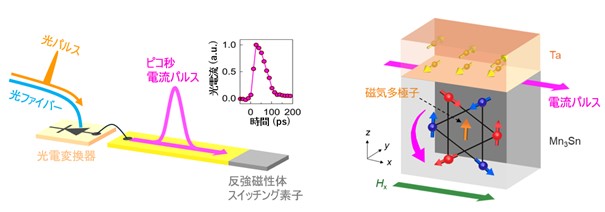
Schematic diagram of nonvolatile quantum switching combining a photoelectric converter and an antiferromagnetic switching element
Paper Information
-
Journal name Science Title of paper Picosecond ultralow-power switching device based on an antiferromagnetAuthors Hanshen Tsai†, Takuya Matsuda†, Kouta Kondou, Kotaro Shimizu, Takuya Nomoto, Tomoya Higo, Takumi Matsuo, Yutaro Tsushima, Mihiro Asakura, Hanyi Peng, Daisuke Nishio-Hamane, Shogo Yamada, Rui Tang, Tetsuya Iizuka, Shinji Miwa, Ryotaro Arita, Mitsuru Takenaka, Satoru Nakatsuji DOI 10.1126/science.adt3136