


DATE2026.05.21 #Press Releases
Phosphorus elemental bonus given by the "birth" of the sun.
Disclaimer: machine translated by DeepL.
Observations of Sun-like Stars Reveal Changes in Phosphorus Content in Galaxies
Summary
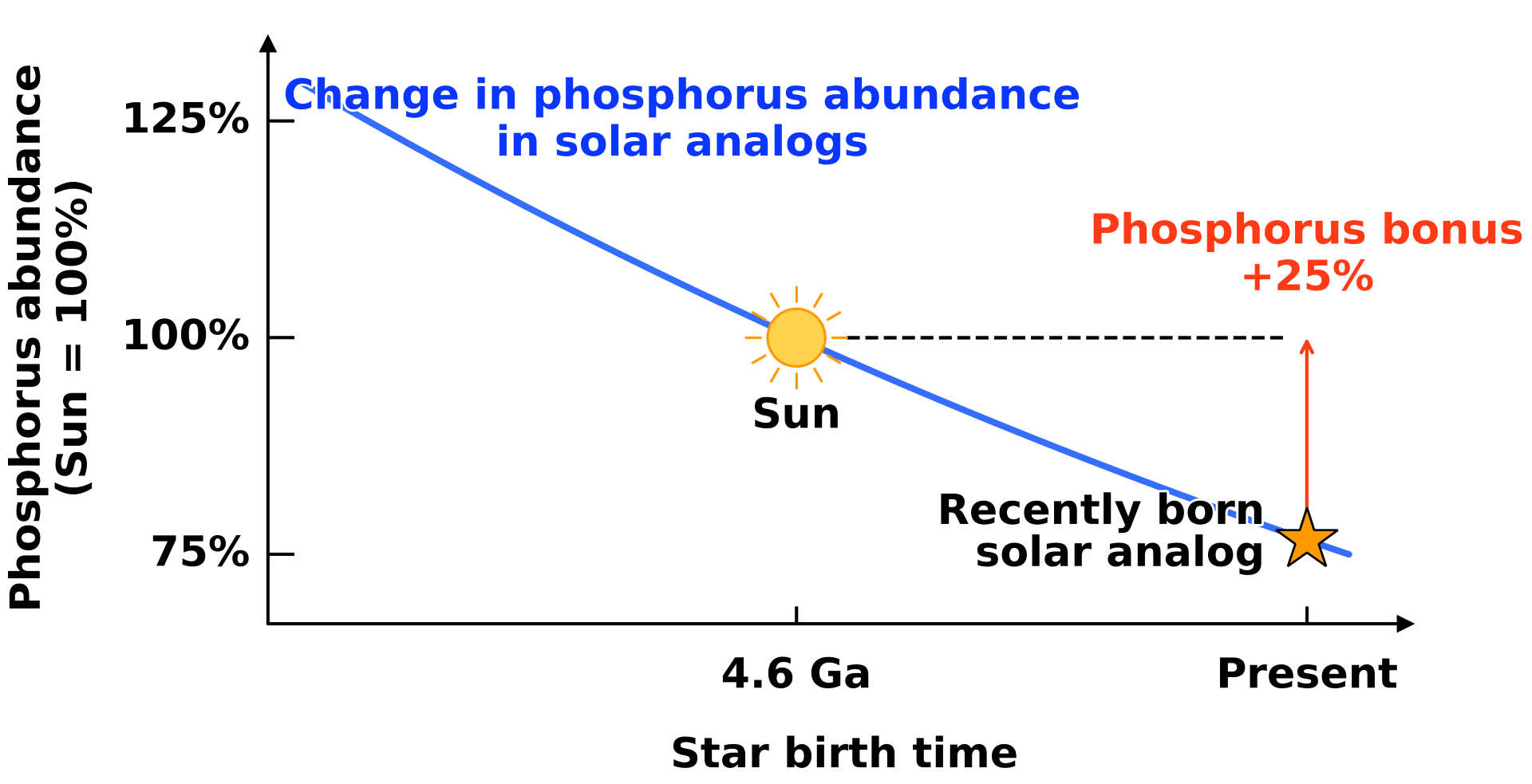
Noriyuki Matsunaga (Assistant Professor, Graduate School of Science, The University of Tokyo) and his research group have revealed from observations of sun-like stars (solar-like stars,) that the increase in phosphorus content in the galaxy varies with time and location within the galaxy. Phosphorus is an element essential for life, and it has been difficult to measure its content using visible light observations. In this study, however, highly accurate measurement of phosphorus content was achieved by using five phosphorus absorption lines that appear in the near-infrared. As a result, we have shown for the first time in the world that there is a clear correlation between the age and phosphorus content of solar-like stars. The age of a solar-like star is considered to be a clue that reflects not only "when" it was born but also "where in the galaxy" it was born. Recent studies have shown a scenario in which the sun was born closer to the inner part of the galaxy than its current position and moved to its current location over a long period of time. Based on the present observations, it is thought that the Sun, which was born earlier in the inner part of the galaxy, was born in a phosphorus-rich environment compared to solar-like stars born in the present solar neighborhood. This result indicates that the solar system received a bonus of the phosphorus element, the material for nurturing life, as a result of its birth in the inner part of the galaxy.
Publication Information
-
Journal Title The Astrophysical Journal Supplement Series Author(s): Noriyuki Matsunaga, Takuji Tsujimoto, Dais Dais Daisy Noriyuki Matsunaga, Takuji Tsujimoto, Daisuke Taniguchi, Hiroaki Sameshima, Shogo Otsubo, Tomomi Takeuchi, Yuki Sarugaku, Ilaria Petralia, Scarlet Elgueta, Matilde Coello-Guzman, Kei Fukue, Yuji Ikeda, Hideyo Kawakita, Valentina D'Orazi, Giuseppe Bono DOI 10.3847/1538-4365/ae5a9d