

DATE2026.05.11 #Press Releases
Elucidating the reality of manganese oxidation that continues from the oxygen miniscule layer to the deep sea
Disclaimer: machine translated by DeepL which may contain errors.
New Material Circulation Model in the Ocean Revealed by Cerium Isotopes
Summary
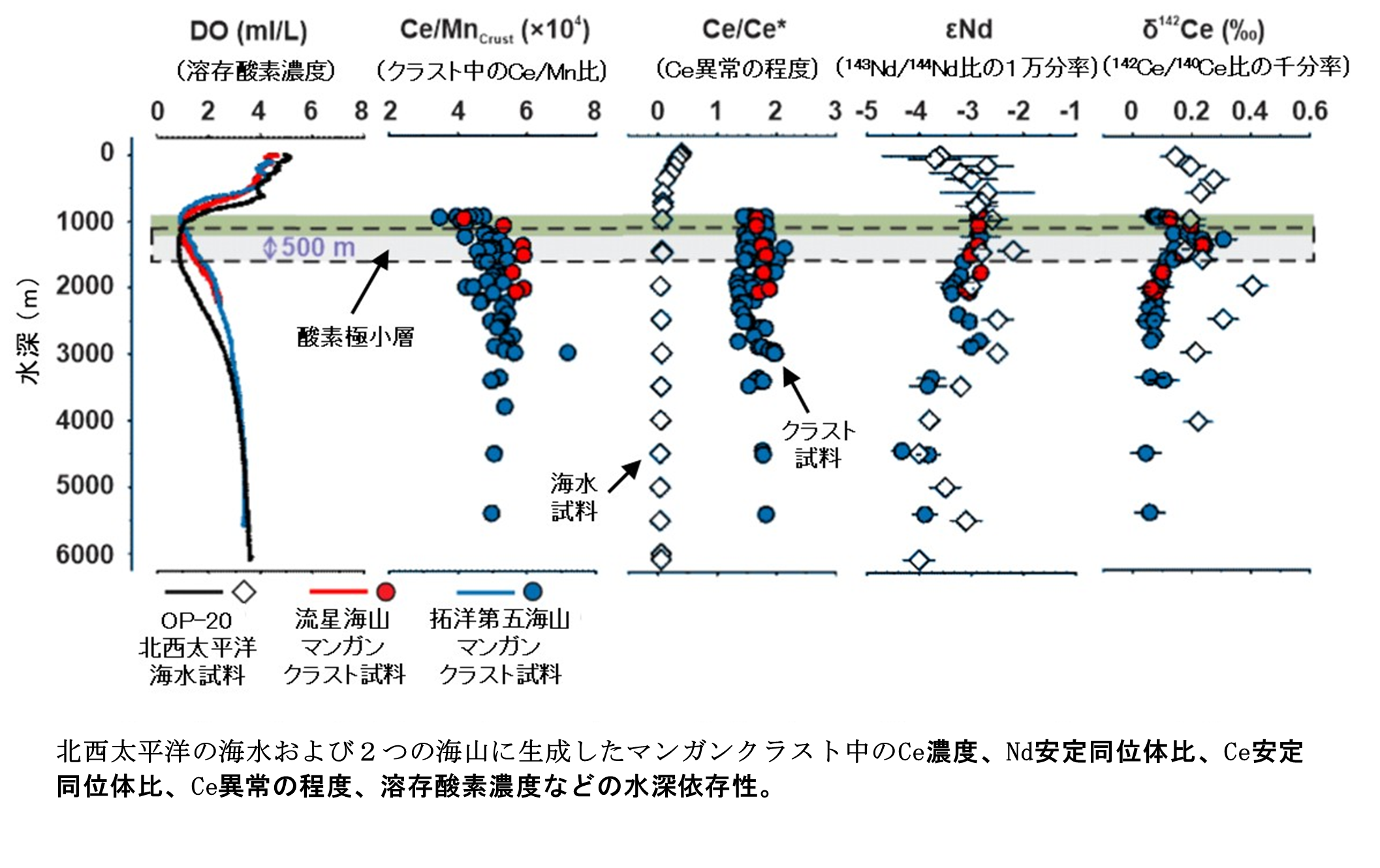
Dr. Li Wenshuai, Graduate School of Earth and Planetary Science, The University of Tokyo (at the time of the research, currently Professor at China University of Geosciences, Wuhan), Professor Yoshio Takahashi (also Director of Isotope Science Center, The University of Tokyo), Dr. Ryoichi Nakata (Senior Staff), Dr. Teruhiko Kashiwabara (Senior Staff), Director of the Japan Agency for Marine-Earth Science and Technology (JAMSTEC), Dr. Akira Usui (Specially Appointed Scientist, Kochi University Marine Core Research Institute) Professor Akira Usui, The University of Tokyo; Professor Hajime Obata, Atmosphere and Ocean Research Institute, The University of Tokyo; Assistant Professor Naoya Hanna (at the time of the research, now Associate Professor at Okayama University); Associate Professor Yoshihiro Asahara, Graduate School of Environmental Studies, Nagoya University; Professor Hirofumi Tazoe, Hirosaki University Dosage Medical Research Institute; Associate Professor Masato Tanaka, Hosei University Natural Science Center; Dr. Naoki Kawamura, Japan Synchrotron Radiation Research Foundation; Dr. Masahiko Kashiwabara, Japan Synchrotron Radiation Research Institute; Dr. Masahiro Usui, International Marine Core Research Institute, Kochi University; Dr. Hajime Obata, The University of Tokyo; Dr. Naoya Kanna, Atmosphere and Ocean Research Institute, The University of Tokyo; Dr. Masahito Tanaka, Hosei University Center for Natural Sciences; Dr. Naoki Kawamura, Japan Synchrotron Radiation Research Institute, Kochi University. The research group led by Dr. Naoki Kawamura, a senior researcher at the Japan Synchrotron Radiation Research Institute, has analyzed the vertical distribution of the stable isotope ratio of cerium (Ce) δ142Ce in seawater and manganese crusts in the Northwest Pacific Ocean, and found that manganese (Mn) oxide formation is continuous from the oxygen minimum layer (OMZ) to deep sea. Mn oxide formation is continuously progressing from the oxygen minimum layer (OMZ) to the deep ocean.
These results revise the conventional model that Mn oxides form and precipitate at specific depths and support a new model that assumes continuous formation over a wide range of depths, including inside the OMZ. The results are expected to greatly advance our understanding of Mn cycling and the behavior of rare earth elements in the ocean, and to be applied as a new geochemical tracer for elucidating the formation process of seafloor mineral resources and for restoring past marine environments.
Publication Information
-
Journal name Science Advances Title of paper Cerium isotopes unveil hydrogenetic Fe-Mn encrustation occurring throughout
from the oxygen minimum zone to the deep PacificAuthor(s) Wenshuai Li, Ryoichi Nakada, Hajime Obata, Naoya Kanna, Inhee Kim, Teruhiko Kashiwabara, Kotaro Higashi, Naomi Kawamura, Yoshihiro Asahara, Hirofumi Tazoe, Masato Tanaka, Akira Usui, Yoshio Takahashi DOI 10.1126/sciadv.aee2813