


DATE2026.04.17 #Press Releases
Discovery of Unexpectedly Large Organic Molecules from Asteroid Ryuguu
Disclaimer: machine translated by DeepL which may contain errors.
Direct Observation of Giant Organic Molecules with Three-Dimensional Structures that Defy Conventional Knowledge
Summary
A research group led by Project Researcher Kota Iwata and Professor Noriaki Sugimoto at Graduate School of Frontier Sciences, The University of Tokyo, in collaboration with a research group led by Associate Professor Yasuhiro Oba at Institute of Low Temperature Science, Hokkaido University, Professor Hiroshi Naraoka at Graduate School of Science, Kyushu University, Professor Hikaru Yabuta at Graduate School of Advanced Science and Engineering, Hiroshima University and Professor Shogo Tachibana of the Graduate School of Science, the University of Tokyo, and his research group have succeeded in directly observing organic molecules contained in samples brought back from the asteroid Ryugu (Note 1) by the Hayabusa2 spacecraft at the single molecule level using a high-resolution atomic force microscope (AFM, Note 2). This study revealed the presence of giant organic molecules with more than 100 rings, which had been overlooked by conventional analytical methods. These organic molecules contain various ring structures such as 5-membered rings (Note 3), 7-membered rings, and even 8-membered rings, indicating that they have a three-dimensional structure rather than a planar structure. This achievement is an extremely important clue to elucidate the evolutionary process of organic molecules inherited from interstellar molecular clouds to asteroids before the formation of the solar system.
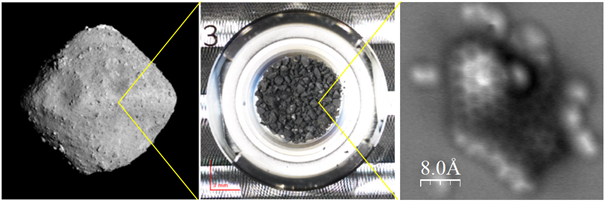 Organic molecules in a sample from the asteroid Ryugu observed by atomic force microscopy
(© JAXA, The University of Tokyo, etc.)
Related Links
Graduate School of Frontier Sciences, The University of Tokyo
Journals
| Journal name |
Nature Communications
|
|---|---|
| Title of paper |