


DATE2026.02.27 #Press Releases
No Fluorine Detected in a Galaxy 12.9 Billion Years Ago
-Revisiting the Conventional View that Wolf–Rayet Stars Are a Major Site of Fluorine Synthesis-
Summary
A research group led by graduate student Akiyoshi Tsujita of the Graduate School of Science, The University of Tokyo, and Professor Chiaki Kobayashi of the University of Hertfordshire observed a galaxy 12.9 billion years ago using the Atacama Large Millimeter/submillimeter Array (ALMA), placing strong constraints on fluorine abundance at the most distant epoch ever probed.
Fluorine is one of the few elements whose astronomical site of production remains uncertain. In particular, the contribution of massive stars known as Wolf–Rayet (WR) stars has long been debated based on studies of stars in the Milky Way. To directly test their role, the team observed a galaxy in the early Universe, when long-lived low-mass stars had not yet significantly contributed to chemical enrichment and massive stars were the primary drivers of chemical evolution. Because the galaxy’s physical properties and evolutionary stage are already well understood, the researchers were able to interpret the observations in a robust way. They searched for hydrogen fluoride (HF), the primary reservoir of fluorine in the interstellar medium. Despite deep observations, no significant HF absorption was detected, placing strong limits on the fluorine abundance at this very early cosmic epoch.
By comparing the observational results with theoretical predictions that incorporate the measured physical properties of the galaxy, the team was able to evaluate how much fluorine should be present if WR stars were a major source of its production. The models indicate that, under such a scenario, the HF signal would have been detectable in the ALMA observations. However, because no such signal was found, the results suggest that WR stars were unlikely to have been the dominant site of fluorine synthesis in this galaxy at this early epoch. These findings call for a reassessment of the conventional view that WR stars played a leading role in supplying fluorine in the early Universe.
In the future, combining ALMA observations with those from the James Webb Space Telescope (JWST) will allow researchers to study a larger sample of well-characterized distant galaxies. Such observations will help further clarify the origin of fluorine and improve our understanding of the internal physical processes of WR stars
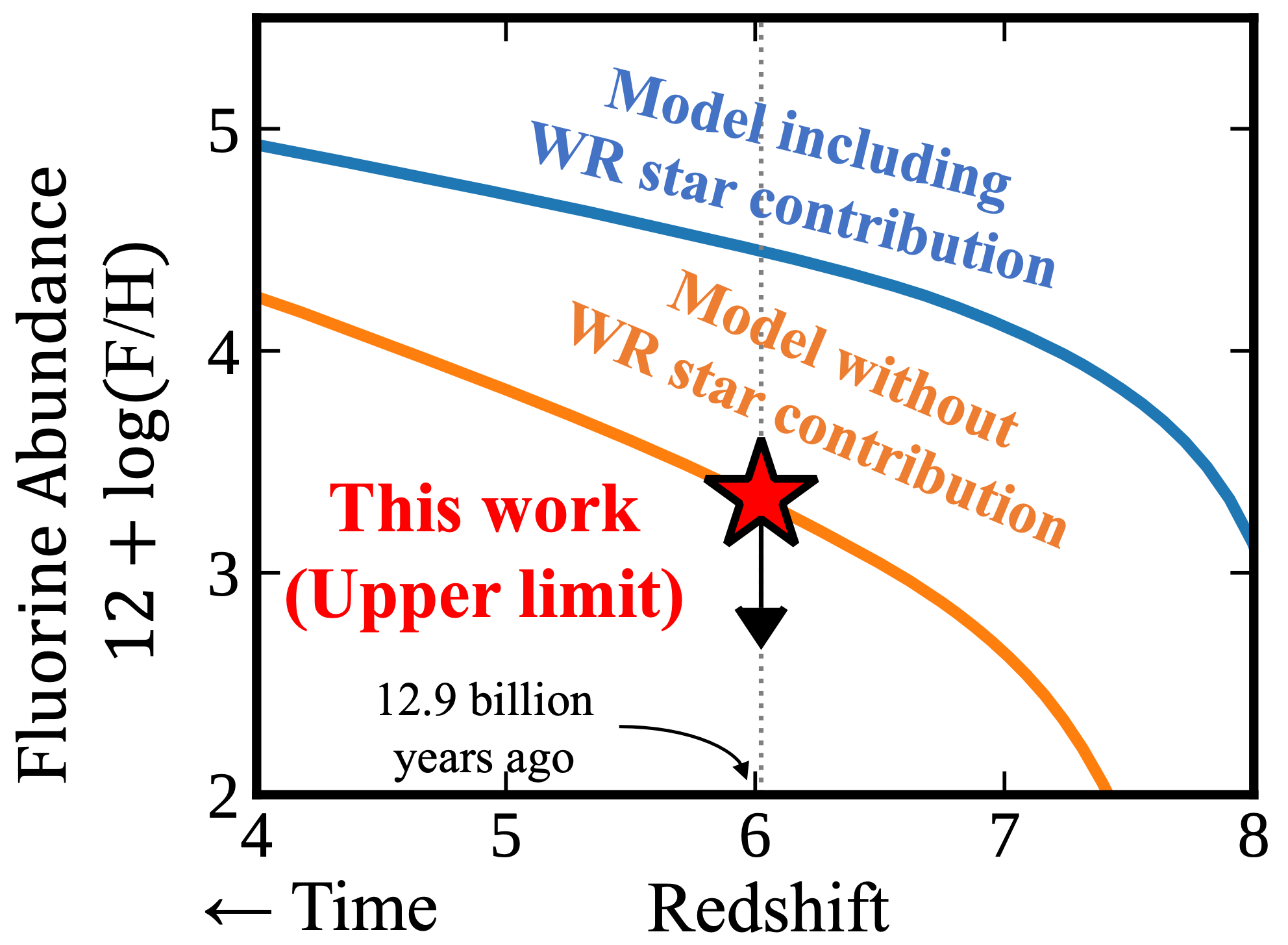
Figure:Comparison between the Observed Fluorine Abundance and Theoretical Models
Journals
-
Journal name The Astrophysical Journal LettersTitle of paper