


DATE2026.04.22 #Press Releases
Four-way improvement in the most common gene editing tool
The new variant contributes to the development of more precise and safer gene therapies
An international research team led by Satoshi N. Omura and Osamu Nureki from the University of Tokyo has engineered a novel variant of the Cas9 protein, a commonly used protein in gene editing technology, called “eSaCas9-NNG”. This novel variant surpasses other variants at all four key performance criteria. As such, it is expected to make a significant contribution to a wide array of applications, such as more precise and safer gene therapies. The findings were published in the journal Nature Communications.
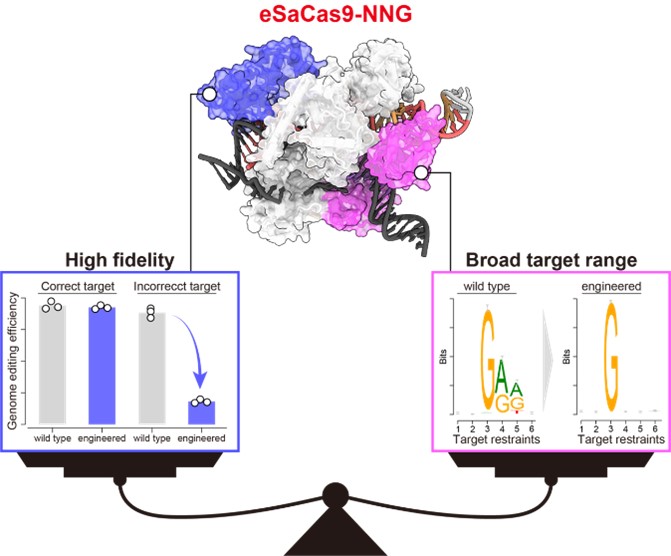
“Performance review” of the protein eSaCas9-NNG
Even though the development of CRISPR, a revolutionary gene editing technology, opened up a wide array of avenues in industries such as agriculture and medicine, the technology itself still has room for improvement. The tool is built upon the Cas9 protein, which, acting as molecular “scissors,” cleaves DNA, allowing for the deletion and addition of unwanted or more favorable sequences. Scientists judge the performance of different types of Cas9 proteins based on four criteria: protein size, editing activity, range of targetable DNA sequences, and target specificity.
“Cas9 variants that can target many DNA sequences often lose accuracy,” says Omura, the first author, “while highly specific variants usually have a narrower target range. In this study, we aimed to overcome this trade-off and engineer a variant with a broad target range and high target specificity.”
The starting point was SaCas9, a commonly occurring variation (wild type) of Cas9 derived from Staphylococcus aureus bacteria. Although this type is widely used due to its activity in living cells, it has a few drawbacks. It requires a specific sequence of amino acid bases, the building blocks of DNA, near the cleavage site, limiting its range of targets. It also has a high tolerance for sequence mismatches, which leads to unintended cleavage. To improve upon all of these properties, the researchers went back to the basics and considered how the chemical properties of proteins give rise to their functions. Then, they introduced mutations into the proteins to understand how changes affected their properties. The final product was named “eSaCas9-NNG.” However, the researchers needed to make sure the protein worked as intended.
“I was surprised by how high the editing efficiency was,” remembers Omura, “when we measured the genome-editing efficiency in the livers of living mice.”
It was not just efficiency: the new protein outperformed the other variants on all of the other performance criteria as well. This means that it is suitable for developing applications, the next step for Omura.
“Our next goal is to work with collaborators to translate eSaCas9-NNG into practical gene therapy applications.”
For more details, please read the article:
Satoshi N. Omura, Ryoya Nakagawa, Shohei Kajimoto, Sae Okazaki, Soh Ishiguro, Hideto Mori, Yuji Kashiwakura, Takafumi Hiramoto, Kio Horinaka, Mamoru Tanaka, Hisato Hirano, Kasey Jividen, Keitaro Yamashita, Shengdar Q. Tsai, Nozomu Yachie, Tsukasa Ohmori, Hiroshi Nishimasu, and Osamu Nureki. 2026. Engineering a compact high-fidelity Staphylococcus aureus Cas9 variant with broader targeting range and mechanistic insights into its activation. Nature Communications. DOI: 10.1038/s41467-026-71626-2