


DATE2025.07.24 #Press Releases
Crossover of Extreme States in Neutron Stars
— A Challenge from Condensed Matter Theory —
Summary
A research group led by Assistant Professor Hiroyuki Tajima and Associate Professor Haozhao Liang of the School of Science at the University of Tokyo, in collaboration with Professor Kei Iida of Kochi University (currently a professor at The Open University of Japan) and Associate Professor Toru Kojo of KEK (High Energy Accelerator Research Organization), has successfully developed a theoretical framework to explain the mechanism of the hadron–quark crossover. This is a continuous transition from hadronic matter to quark matter expected to occur inside high-density astrophysical objects such as neutron stars, as illustrated in Figure 1.
While observational data of neutron stars are gradually revealing the potential existence of quark matter within their interiors, how hadronic matter transitions into quark matter at the core remains an open question. In this study, the researchers approached this issue by drawing inspiration from a condensed matter phenomenon known as the "BEC–BCS crossover." By applying a theory that describes the BEC–BCS crossover observed in condensed matter systems, the team succeeded in constructing a unified framework that explains both the increase in the speed of sound and the formation/dissociation processes of hadrons. This achievement represents a significant step toward a deeper understanding of physical phenomena under extreme conditions.
The results are expected to greatly contribute to the cross-disciplinary understanding of many-body problems. Furthermore, because the theory is based on quantum field theory, it offers higher versatility compared to previous studies and is anticipated to be beneficial for future research into high-density astrophysical objects.
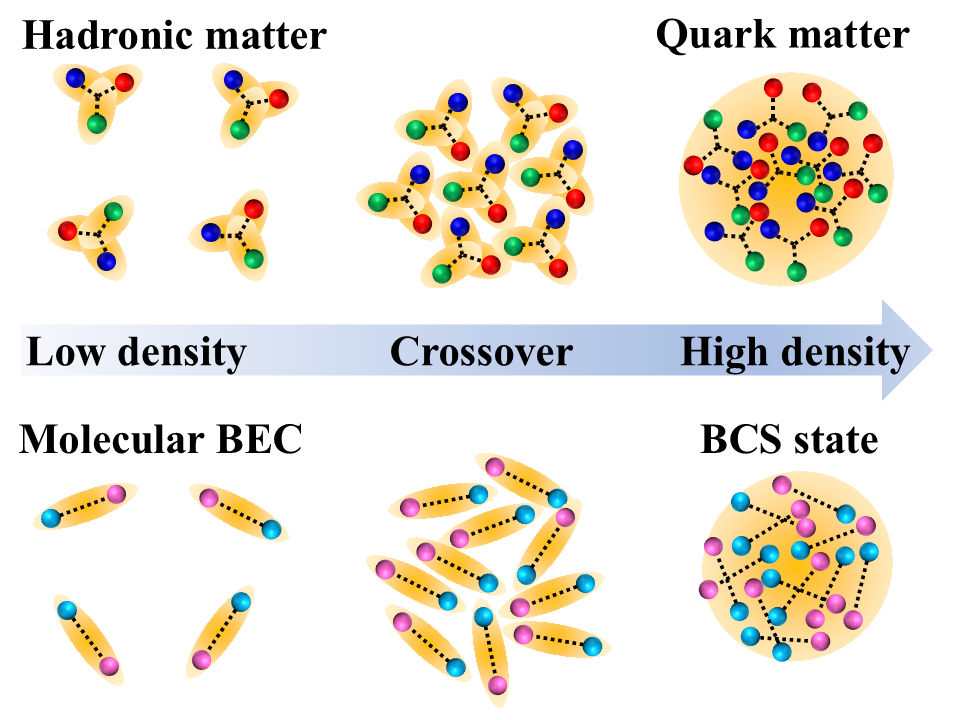 Figure: Comparison Between the Hadron–Quark Crossover and the BEC–BCS Crossover
Journals
-
Journal name Physical Review Letters
Title of paper Tripling Fluctuations and Peaked Sound Speed in Fermionic Matter