


DATE2025.07.09 #Press Releases
How to form sharp tips in leaf?
Summary
The remarkable diversity of leaf shapes in land plants is not only visually striking but also functionally important. Among these, sharply elongated, tail-like leaf tips—classified as “acuminate,” “acute,” or “cuspidate”—have been described for centuries, serving essential roles such as promoting rainwater drainage. However, the developmental mechanisms underlying these sharp tips have remained unclear.
Researchers from the University of Tokyo and Kyoto University, led by Prof. Hirokazu Tsukaya and Prof. Atsushi Mochizuki, have now elucidated how these structures form, publishing their findings in The Plant Journal. The team used the Chinese tallow tree (Triadica sebifera), a species with leaves consisting distinct acuminate tips, concave joints, and rounded bases, making it an ideal model for studying sharp tip formation (Fig. 1 left).
By analyzing leaf development from early primordia to mature forms, the researchers combined detailed experimental observation with computational modeling. Their work revealed a biregional pattern of cell division: at the leaf apex, cells divide predominantly in the vertical direction, whereas at the base, divisions occur randomly (Fig. 1 middle and right). Computational simulations showed that vertical cell divisions at the apex drive tip elongation and sharpening, while random divisions at the base result in a rounded shape (Fig. 1 middle; Movie 1).
Simulations based on this mechanism successfully reproduced leaf tips of varying lengths and sharpness, confirming that spatial regulation of cell division orientation is fundamental for shaping sharp leaf tips.
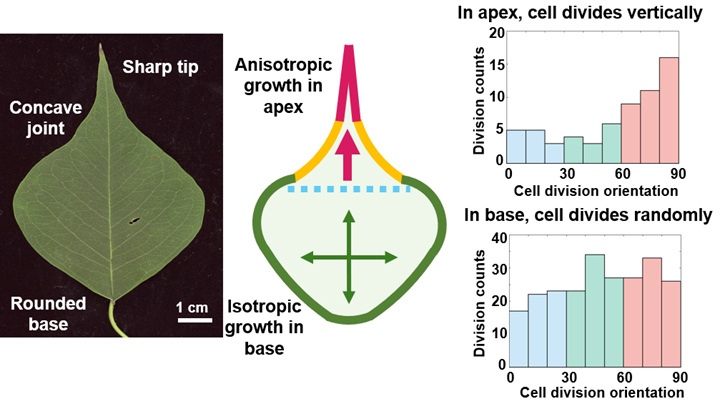
Figure 1. Research summary. Left: the mature leaf of Triadica sebifera possesses sharp tip, concave joints and rounded base. Middle: diagram of biregional growth in T. sebifera leaf. Right: apical cells divided biasedly in vertical direction, and basal cells divided in random direction.

Links
Journals
-
Journal name The Plant Journal
Title of paper Biregionally differentiated growth generates sharp apex and concave joints in leaves