


DATE2025.03.06 #Press Releases
New Mechanism of Plant Cell Wall Remodeling Unveiled
~A new avenue for plant improvement, including harvest-friendly forms and improved drought stress tolerance~
Summary
A research group led by Researcher Saku Kijima (currently a researcher at the Biological Process Research Division of the National Institute of Advanced Industrial Science and Technology), Assistant Professor Takema Sasaki, undergraduate student Yuichiro Kikushima, and Professor Yoshihisa Oda from the Graduate School of Science, Nagoya University, in collaboration with Associate Professor Daisuke Inoue from the Faculty of Design, Kyushu University, Professor Yuki Kondo from the Graduate School of Science, Osaka University, Associate Professor Soichi Inagaki from the Graduate School of Science, The University of Tokyo, Senior Chief Researcher Shingo Sakamoto and Deputy Director Nobutaka Mitsuda from the Biological Process Research Division of the National Institute of Advanced Industrial Science and Technology, and Associate Professor Masatoshi Yamaguchi from the Graduate School of Science and Engineering, Saitama University, has uncovered a novel mechanism by which plants regulate the structure of their cell walls.
In this study, the research group newly isolated a mutant of Arabidopsis thaliana that exhibits abnormalities in the structure of vascular cell walls. They identified the causal gene as KNAT7, which suppresses the expression of the FORMIN11 (FH11) gene. When KNAT7 was nonfunctional, the expression of FH11 increased, leading to excessive production of the FH11 protein. FH11 promotes actin polymerization at the cell membrane, resulting in an increase in actin filaments, which in turn altered the structural type of the vascular cell wall. In other words, plants regulate the structure of their cell walls by adjusting the amount of actin polymerization.
The plant cell wall, which surrounds plant cells, plays a crucial role in determining cell shape, supporting leaf and root growth, and responding to various stresses. By applying the findings of this study to artificially control plant cell wall structures, it is expected that technologies could be developed to create plant varieties with more easily harvestable forms or increased resistance to drought stress.
The results of this study were published in the journal Nature Communications on February 26, 2025.
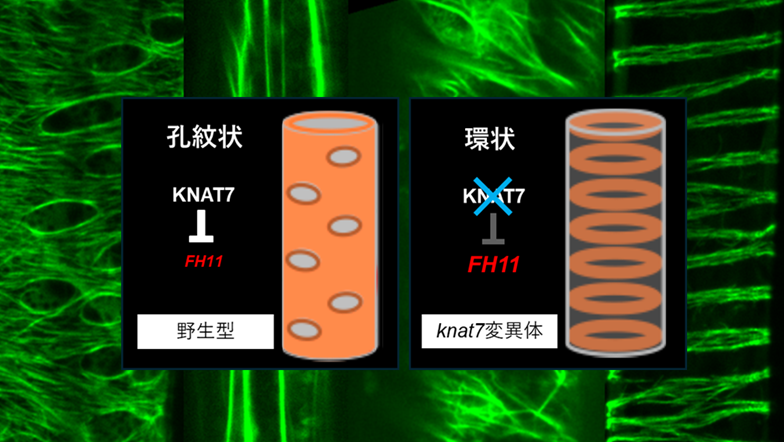
Figure: Mechanism determining cell wall structure
Related links: Nagoya University, Kyushu University, Osaka University, National Institute of Advanced Industrial Science and Technology(AIST), Saitama University
Published Journals
-
Journal name Nature CommunicationsTitle of paper