


DATE2026.10.13 #Press Releases
Structure in the unstructured: new phenomenon discovered in the solar wind
A new mechanism of plasma turbulence in the solar wind was discovered by an international research group
Turbulence is ubiquitous and occurs in our everyday lives on Earth, such as when milk is stirred into coffee, or in the stormy motions of the ocean and the atmosphere. Media in space and astrophysical systems can also develop turbulence, but the physics is different because the medium is in an ionized state (known as the plasma state) and the flow motion is strongly coupled to electromagnetic fields. Furthermore, space plasma is collisionless because the medium is so dilute that the particles do not collide with each other. How does plasma develop into turbulence? How is the fluctuation energy distributed in collisionless turbulence? Turbulence in space plasma remains a mystery in physics.
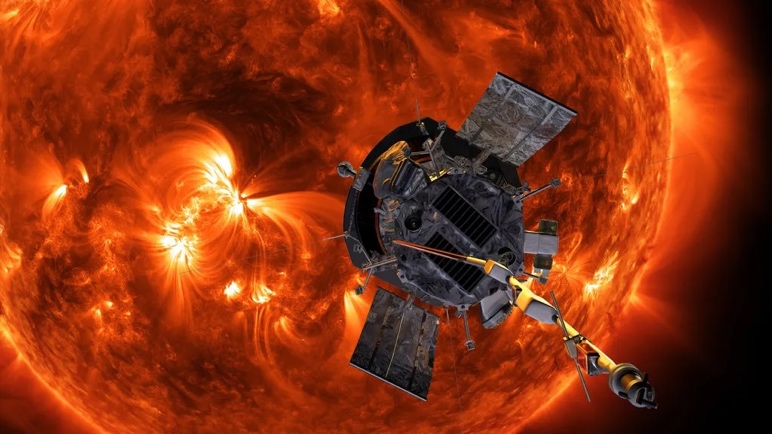
Artist's illustration of NASA's “Parker Solar Probe” mission. Credits: NASA/Johns Hopkins APL/Steve Gribben
An international research team from the Technische Universität Braunschweig and University of Tokyo in cooperation with Tohoku University, Kyushu University, Osaka University, and multinational research institutes has now demonstrated, for the first time, a reversal phenomenon of magnetic field rotation in space turbulence. A structure emerges within the unstructured space plasma. The results are published in The Astrophysical Journal Letters.
The team from the Institute of Theoretical Physics at the Technische Universität Braunschweig and University of Tokyo in collaboration with researchers from a total of ten countries, has demonstrated a fundamentally new phenomenon. Using high-precision magnetic field and particle data from NASA’s Parker Solar Probe mission, the team showed directly for the first time that the turbulent magnetic fields exhibit a clear reversal of the magnetic field rotation sense over a certain wavelength, and even that the reversal grows and shifts toward longer wavelengths in the radial direction away from the Sun. The reversal coincides with the transition from large-scale, fluid-like dynamics to small-scale, particle-like dynamics.
The discovery of a small-scale phenomenon has a big impact in science
On larger length scales, space plasma behaves like a fluid, and turbulence develops through excitation of vortices and electromagnetic waves. The fluctuations become random, that is, turbulent. However, the magnetic field rotation is not random. The fields preferentially rotate counterclockwise when seeing radially away from the Sun. The rotation, however, looks different on smaller length scales. The fields rotate clockwise when one looks at the turbulent plasma on smaller length scales. This scale just happens to be at the transition scale from flow-like behavior in the plasma to particle-like behavior.
“We see a clear structure in the spectrum, even though the turbulence represents unstructured motions,” says Dr. Masatomi Iizawa (TU Braunschweig), the first author of the article.
Dr. Yokoi (University. of Tokyo) stresses the importance of this finding, “The results are of great significance for both plasma physics and astrophysics.”
A structure forms when the space plasma becomes turbulent, and the key insight lies in the transition from fluid dynamics to particle dynamics. Plasma turbulence plays an important role in astrophysics, such as in the Earth’s magnetosphere, the solar wind, solar eruption, interplanetary space, and accretion disks. Turbulence in space plasma can influence the shock waves and magnetic clouds in interplanetary space produced by solar eruption and is a very important factor in predicting geomagnetic storms.
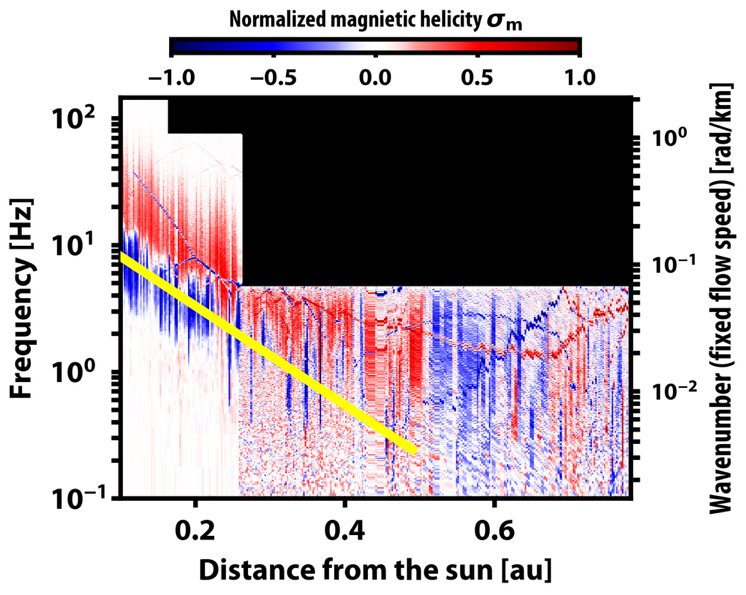
Reversal of the field rotation. Credits: Iizawa et al., Astrophys. J. Lett., 2026.
For more details, please read the article:
Masatomi Iizawa, Yasuhito Narita, Tommaso Alberti, Stuart D. Bale, Axel Brandenburg, Abraham C.-L. Chian, Horia Comis, Shuichi Matsukiyo, and Nobumitsu Yokoi. 2026. Nonlocal Evolution of Magnetic Helicity across the Magnetohydrodynamic–Kinetic Interface. The Astrophysical Journal Letters. DOI: 10.3847/2041-8213/aea84b