


DATE2026.10.09 #Press Releases
Biopolymer Chitin Detected in a 120-Million-Year-Old Fossil
Disclaimer: machine translated by DeepL which may contain errors.
—New Developments in Molecular Paleontology Paved by “Early Silicification” Associated with the Influx of Cretaceous Wildfire—
Summary
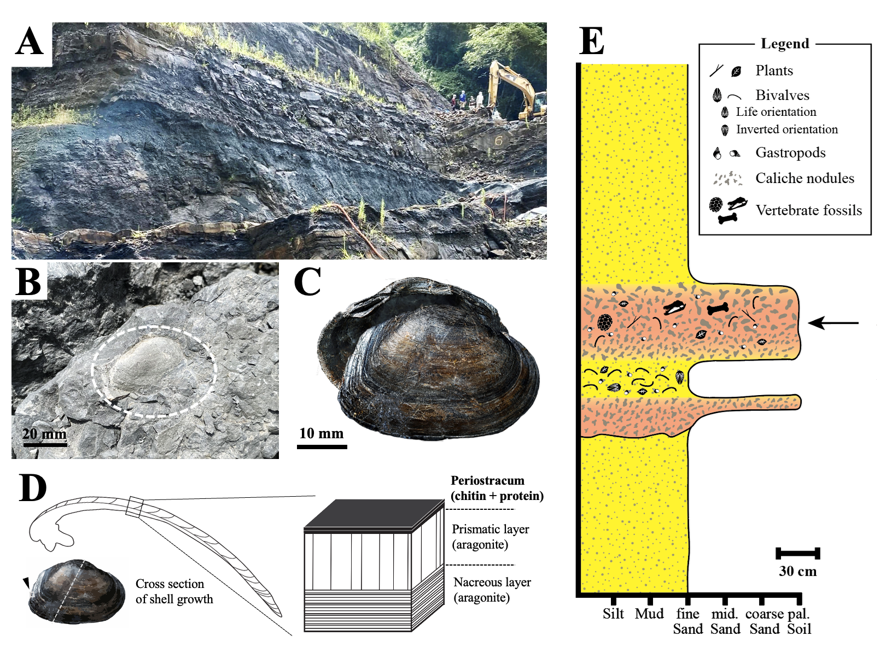
A joint research group consisting of Taro Yoshimura, Project Researcher at The University Museum, The University of Tokyo (at the time of the research: Ph.D. candidate, Graduate School of Science, The University of Tokyo); Associate Professor Takenori Sasaki; and Researcher Kentaro Nakayama, Researcher Kaito Asato, and Senior Researcher Yoshikazu Noda of the Fukui Prefectural Dinosaur Museum, discovered that β-chitin, a biological macromolecule, is exceptionally well-preserved at the molecular level in the fossil shells of the freshwater bivalve Nakamuranaia soni, which was recovered from the Kitadani Formation of the Tetori Group—dating to the Early Cretaceous (approximately 120 million years ago)—in Katsuyama City, Fukui Prefecture. Although it has been generally accepted that organic matter cannot be preserved long-term in freshwater river environments with high microbial activity, the team demonstrated—through electron microscopy, fluorescent staining, and Fourier-transform infrared spectroscopy (FT-IR)—that the honeycomb-like structure and molecular framework of the chitin, which are very similar to those of living species, have been preserved. Furthermore, we elucidated that a naturally formed silica film—formed on the shell surface very early after death by silica-supersaturated water originating from wildfire-derived ash—functioned as a protective barrier (taphonomic shield) that blocked microorganisms and degradative enzymes. These findings represent a significant leap back in time compared to previous reports, which primarily focused on the Cenozoic Era (approximately 40 million years ago), and extend the record of chitin molecule preservation in freshwater biominerals to approximately 120 million years ago.
.png)
Cretaceous freshwater bivalve fossils from a dinosaur fossil-bearing layer and a schematic illustration of shell microstructure
Journals
-
Journal name GeobiologyTitle of paper