


DATE2026.08.20 #Press Releases
Bridging Ambient- and High-Pressure Superconductivity in La₂LnNi₂O₇ Films
Disclaimer: machine translated by DeepL which may contain errors.
— High Pressure on Strained Films Reveals a Continuous Evolution Between Two Superconducting Regimes —
Summary
Assistant Professor Motoki Osada, Professor Atsushi Tsukazaki, and Distinguished University Professor Yoshinori Tokura (Tokyo College, The University of Tokyo Institutes for Advanced Study) of the Graduate School of Engineering, The University of Tokyo; Senior Engineer Chieko Terakura of the RIKEN Center for Emergent Matter Science;Researcher Jean-Baptiste Morée, Senior Engineer Akiko Kikkawa, and Senior Researcher Masamichi Nakajima from the Graduate School of Engineering at The University of Tokyo; Associate Professor Shusaku Imajo from the Graduate School of Frontier Sciences at The University of Tokyo; Assistant Professor Hsiao-Yi Chen and Professor Yusuke Nomura from the Institute for Materials Research at Tohoku University;Professor Koichi Kindo of the Institute for Solid State Physics at The University of Tokyo, and Professor Ryotaro Arita of the Graduate School of Science at The University of Tokyo, among others, have fabricated a lattice-strained bilayer nickel oxide thin film that exhibits superconductivity at ambient pressure and investigated its superconducting properties through measurements under strong magnetic fields and high pressure.
This study revealed that the superconducting transition temperature, which was approximately 40 K at ambient pressure, rises to a maximum of 73 K at 16 GPa (gigapascals). This marks the first time that high-pressure superconductivity and ambient-pressure superconductivity—which had previously been studied independently—have been realized in thin-film samples of the same material system(Figure 1). These findings are expected to contribute to a better understanding of the mechanisms underlying high-temperature superconductivity and to the design of new high-temperature superconducting materials.
These research findings were published in the online edition of the scientific journal *Nature Materials* (August 18).
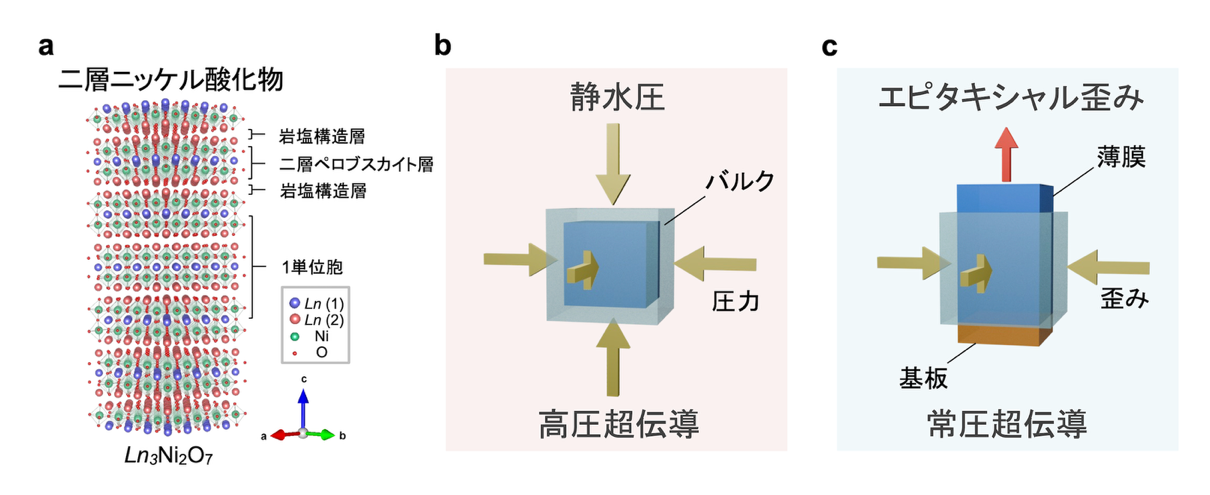
Figure 1: Schematic diagram of the crystal structure of a bilayer nickel oxide and hydrostatic pressure and epitaxial strain
a. Crystal structure of the bilayer nickel oxide Ln3Ni2O7 (Ln: rare earth element). Bilayer perovskite layers and rock-salt structure layers are stacked alternately.b. Application of hydrostatic pressure to a bulk sample. Under hydrostatic pressure, the crystal is compressed from all directions, causing both the in-plane and out-of-plane lattices to contract.c. Epitaxial strain. In thin films, a difference in lattice constants between the film and the substrate induces in-plane epitaxial strain, which causes the lattice to stretch in the out-of-plane direction.
Links
Graduate School of Engineering, The University of Tokyo
Journal
| Journal Name | Nature Materials |
|---|---|
| Paper Title |
Bridging Ambient- and High-Pressure Superconductivity in La₂LnNi₂O₇ Films |