


DATE2026.07.31 #Press Releases
Quantum Acceleration Sensing Using Levitating Nanoparticles Achieved
Disclaimer: machine translated by DeepL which may contain errors.
—Developing a Dynamic Method to Overcome Limitations Caused by Quantum Fluctuations—
Summary
A research group comprising Mitsuyoshi Kamba, Project Researcher; Sotatsu Otabe, Project Assistant Professor; and Kiyotaka Aikawa, Associate Professor, at the Graduate School of Science, The University of Tokyo, in collaboration with Professor Takahiro Sagawa and Lecturer Ken Funo of the Graduate School of Engineering at the same university, has developed a technology that measures the acceleration acting on a nanoparticle suspended in a vacuum, thereby breaking through the limits imposed by quantum mechanical fluctuations.
In this study, the researchers first trapped a nanoparticle with a diameter of approximately 300 nanometers in a laser-generated potential and cooled its motion to near the quantum ground state , which is the lowest energy level.They then manipulated the nanoparticle’s motion by controlling the laser’s output intensity (Fig. 1) and, by creating a state sensitive to acceleration, succeeded in measuring the minute gravitational acceleration acting on the nanoparticle.Originally, within an optical potential, the zero-point oscillation —a quantum mechanical fluctuation of the ground state—acts as a constraint, masking the effects of acceleration.However, in this study, by precisely controlling the optical potential, they succeeded in amplifying the displacement of nanoparticles caused by acceleration, thereby improving the acceleration detection sensitivity by two orders of magnitude compared to conventional methods.They also performed comparisons with theoretical simulations and found that the observed dynamics and sensitivity can be well explained by the quantum Langevin equation. This study has demonstrated sensing utilizing dynamics near the quantum ground state, which had not been achieved previously.
Sensing the acceleration acting on nanoparticles is a technology expected to play a central role in next-generation quantum sensing, such as the detection and measurement of dark matter and neutrinos, and the detection of high-frequency gravitational waves.It is also expected to contribute to fundamental research exploring how gravity and electromagnetic forces interact in the study of quantum mechanics on the macroscopic scale.
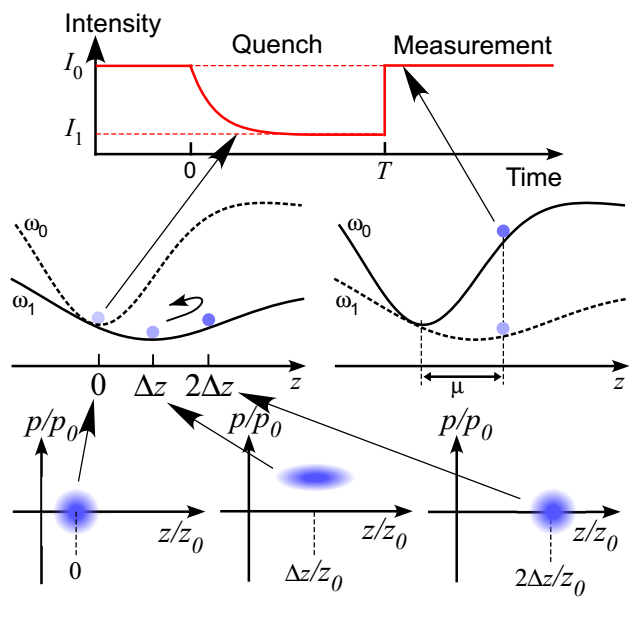
Figure 1: Timeline of the experiment and a schematic diagram of fluctuations in phase space
By controlling the laser light intensity, the system is transitioned from a state suitable for cooling to the quantum ground state to a state suitable for acceleration sensing; by measuring displacement at the optimal timing in the low-light-intensity state, weak accelerations—which would otherwise be masked by zero-point oscillations in the original potential—can be detected.(Top) Temporal variation in light intensity. (Middle) Schematic diagram of nanoparticle motion in a light potential. (Bottom) Changes in the particle’s position and its fluctuations in phase space, which consists of position and momentum.
Journal
-
Journal Name Physical Review Letters Paper Title Levitated Nano-Accelerometer Sensitized by Quantum QuenchAuthors M. Kamba, S. Otabe, K. Funo, T. Sagawa, K. Aikawa DOI 10.1103/js43-kq48