


DATE2026.07.02 #Press Releases
Simultaneous Screening for Novel Enzymes That Modify Peptides Using the “Mixed-Method” Approach
Disclaimer: machine translated by DeepL which may contain errors.
—Expansion of the Enzyme Repertoire Enabling Lipid Attachment to Peptides—
Abstract
A research group led by Professor Yuki Goto of the Graduate School of Science at Kyoto University (formerly Associate Professor in the Suga Laboratory), Professor Hiroaki Suga and Associate Professor Masayuki Satake of the Graduate School of Science at The University of Tokyo; Associate Professor Toru Sengoku of the Graduate School of Medicine at Yokohama City University;Assistant Professor Keisuke Hamada of the Graduate School of Medicine, Yokohama City University; and Professor Masahiro Okada of the Faculty of Chemistry and Life Sciences, Kanagawa University—have developed a new method for efficiently identifying enzymes (prenyltransferases) that attach lipids to peptides and have successfully discovered numerous novel enzymes.
Peptides are molecules composed of a few to several dozen amino acids linked together, and they play various roles in the body, such as hormones and neurotransmitters.Many peptides also exhibit excellent biological activity and are expected to be used as pharmaceuticals. On the other hand, peptides are easily broken down in the body in their natural state and are rapidly excreted, making it difficult to maintain their activity for extended periods.To address these challenges, lipids are often attached to peptides in pharmaceutical development. To freely modify the properties of the resulting peptides, there is a need to develop technologies that allow for the selective attachment of lipids to targeted sites.
Enzymes are proteins with catalytic activity that can selectively recognize specific positions on particular molecules to catalyze chemical reactions.Prenyltransferase, an enzyme that attaches a prenyl group—a type of lipid—to peptides, can also selectively modify specific positions on peptides and is expected to serve as a tool for attaching lipids to peptides.In previous screening studies of prenyl transferases, the mainstream approach involved examining the function of candidate proteins one by one using natural substrates (the molecules on which the enzyme acts), which required a great deal of time and effort.In this study, we developed a new method—which could be called the “mixed artificial substrate method”—that involves reacting various artificial peptides without relying on natural substrates, enabling the simultaneous evaluation of the enzymatic functions of candidate proteins.
As a result, we identified as many as 14 new types of prenyltransferases, successfully doubling the number of known members of this enzyme family. Furthermore, we discovered several previously unknown lipid attachment patterns (prenylation modes).Furthermore, by analyzing the three-dimensional structures of the discovered enzymes, we have elucidated the mechanism by which subtle structural differences in proteins give rise to diverse reactions. These findings are expected to serve as a foundational technology to accelerate the design and functional modification of various functional molecules and peptide drug candidates.Moving forward, we will work to utilize the enzymes discovered in this study while also applying this approach to other types of enzymes, with the goal of creating a wider variety of functional molecules.
These research findings were published online on July 1, 2026, in the international academic journal *Nature Catalysis*.
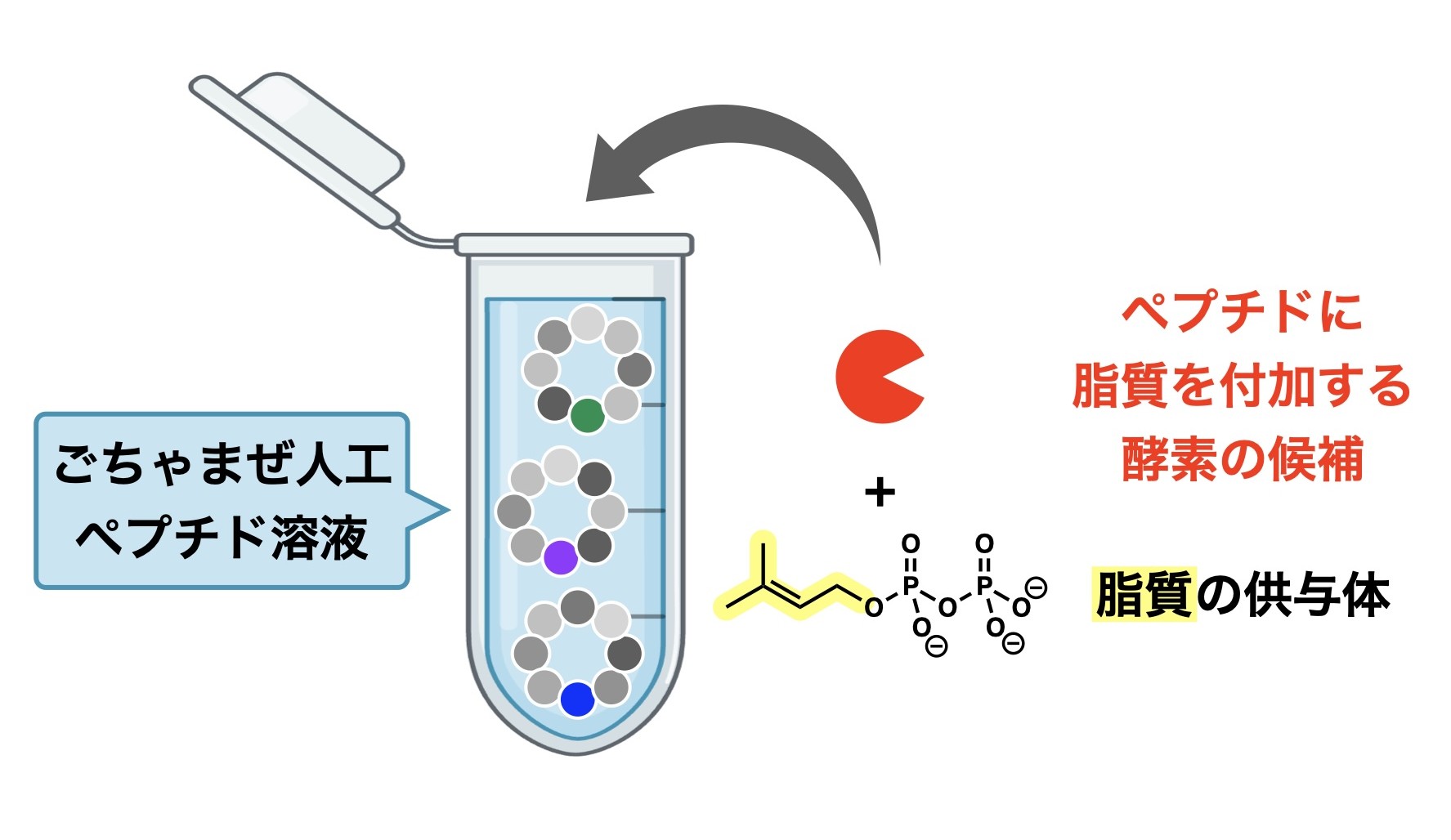 Schematic of the novel enzyme discovery method developed in this study. Created with BioRender.com
Related Links
Graduate School of Science, Kyoto University
Journal
| Journal Title |
Nature Catalysis
|
|---|---|
| Paper Title |