


DATE2026.06.30 #Press Releases
High-precision engineering of average cell size in fruit fly wings
Scientists reveal distinct cell groups and their self-organized behavior during development
Researchers led by Kaoru Sugimura from the University of Tokyo have identified the mechanism that ensures average cell size is constant across samples of developing Drosophila melanogaster (fruit fly) wings.They have found that rather than every cell behaving in the same way, several distinct groups of cells that differ in when and how many times they divide work together to reproduce the average cell size with remarkable precision. This new framework for understanding how developing animal tissues control cell size could widen avenues for research into conditions associated with abnormal cell size, such as cardiac hypertrophy and cancer. The findings were published in the journal Development.
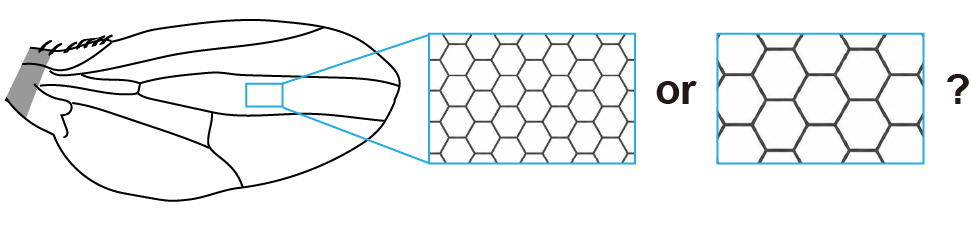
Schematic of the Drosophila wing and the epithelial cells that compose it
Cell size on its own might seem to be too simple to matter in organisms made up of millions of cells and billions of interactions. However, cell size influences not only biochemical efficiency but also the structural integrity of each and every one. As such, what controls cell size has been thoroughly researched… with a caveat: most research focuses on single-cell organisms or cultured cells that can divide freely.
“Developing tissues face much stricter constraints,” explains Sugimura, “because cell proliferation occurs only during a limited developmental period. We were interested in how precise cell-size control is achieved under developmental constraints.”
The researchers set out to follow the development history of individual cells in the developing fruit fly wing. They first recorded the development of the fruit fly pupal wing over time with the help of computer-assisted image analysis. They then reconstructed how much each cell grew, when they divided, and what their positions were using these data. Comparison of these histories revealed that the tissue was in fact made up of several distinct groups of cells differing in when and how many times they divided. Observing such variety within a sample could lead to the assumption of variety across samples too.
“The average cell size of different groups over time was so reproducible across samples,” Sugimura remembers, “that I initially thought something must be wrong with the analysis. After carefully checking the data and the code, I realized the result was real. It remains the most beautiful graph I have ever plotted.”
The different groups of cells achieved this remarkable precision by controlling for the number of divisions and the initial size of the cells. Their positions were also found to vary with respect to longitudinal veins, rather than being random. Despite this plethora of findings, Sugimura is already thinking about the next step.
“We are interested in whether the division-control mechanisms identified in Drosophila melanogaster are conserved or evolutionarily modified to accommodate different wing geometries and patterning.”
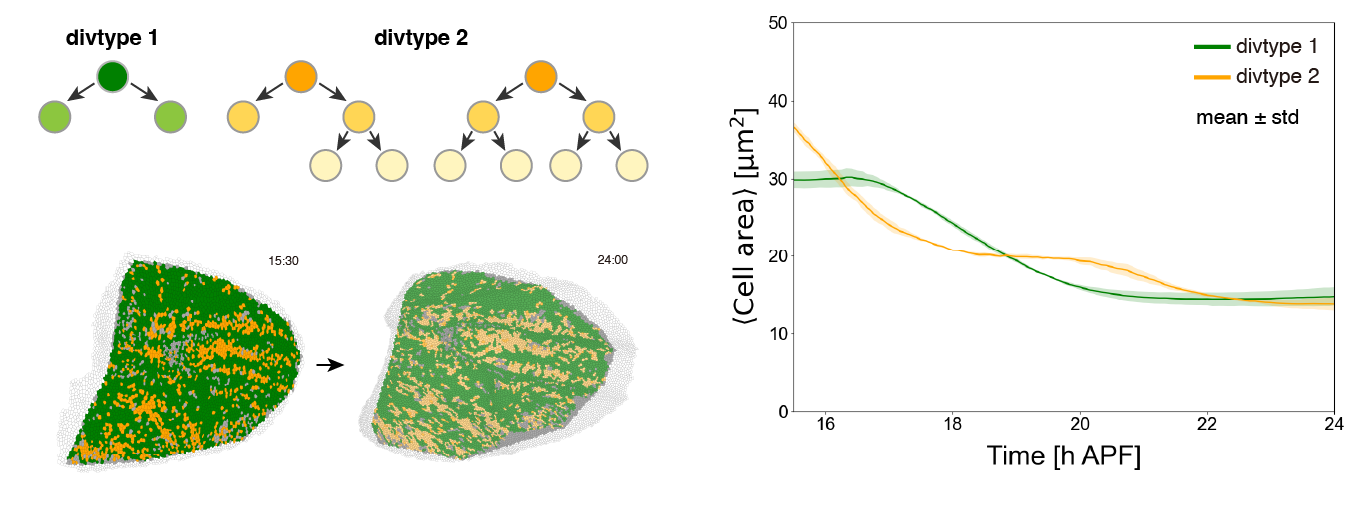
Distinct cell populations coordinate precise cell-size control in the Drosophila wing
For more details, please read the article:
Kaoru Sugimura, Ryu Takayanagi, Toshinori Namba, Zeping Qu, and Shuji Ishihara. 2026. Cell size control emerges from the vein-dependent coordinated divisions of distinct cell groups in Drosophila wing. Development. DOI: 10.1242/dev.205474