
DATE2026.05.28 #Press Releases
Successful lifetime measurement of tellurium 104, the fastest alpha-decaying
Disclaimer: machine translated by DeepL which may contain errors.
Discovery of Formation of Extremely Strong Alpha Clusters in the Vicinity of the Double Magic Nucleus
Summary
An international research group led by Senior Research Scientist Shunji Nishimura and Group Director Hiroki Sakurai of the Radioactive Isotope Physics Group, Technical Scientist Naoki Fukuda of the BigRIPS Team, and Research Scientist Shintaro Go of the Nuclear Structure Research Group, all at the RIKEN Nishina Center for Accelerator-based Science, Assistant Professor Rin Yokoyama of the Center for Nuclear Study, Graduate School of Science, The University of Tokyo, Assistant Professor Noritaka Kitamura of the Graduate School of Science, The University of Tokyo, Research Fellow Ian Cox and Professor Robert Grzywacz of the University of Tennessee, and Research Scientist Tobias King of Oak Ridge National Laboratory have succeeded in directly measuring the alpha (α) decay of tellurium-104 ( 104Te ), a very short-lived radioisotope (RI), for the first time, and found that its half-life is approximately 7.2 nanoseconds (1 nanosecond is one billionth of a second). This is the fastest α-decay from the ground state known to date.
This achievement deepens our understanding of the formation of α-cluster structures in nuclei and also leads to the elucidation of nuclear structures in the vicinity of magic numbers.
In α-decay, an α-particle (helium nucleus) consisting of two protons and two neutrons is formed inside a nucleus and is ejected out of the nucleus due to the quantum tunneling effect and other factors. Based on the measured decay probabilities, the international research group derived the α-particle formation probability, which indicates the degree to which α-particles are formed inside the nucleus. As a result, it was found that the α-particle formation probability of 104Te is the highest among all known α-decay nuclei, and is about twice that of known nuclei. This high α-particle formation probability is thought to be closely related to the unique structure of 104Te that decays to a doubly magic nucleus, 100 tin ( 100Sn ).
This study will be published in the scientific journal Nature on May 27 (May 28 Japan time).
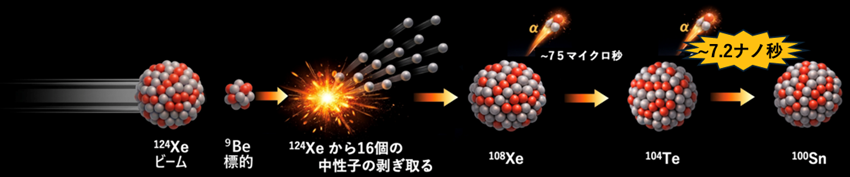 The process from 124Xe through 108Xe and 104Te to the double magic nucleus 100Sn
Links
Journals
| Journal name |
Nature
|
|---|---|
| Title of paper |