


DATE2026.04.30 #Press Releases
Tiny molecular quantum thermometer can measure the insides of cells
A new way to record temperatures at microscopic scales with incredibly high precision
It’s trivial to measure something like body temperature, but it becomes increasingly difficult to measure the temperature of ever smaller tissues or samples such as on a sub-cellular level. This kind of measurement is sought after as it’s known that important biological processes, including those linked to diseases, impact the temperature of cellular components in different ways. While prior methods to measure sub-cellular temperatures exist, they have drawbacks which limit their potential as an aid for diagnostic or research tools. For the first time, a team including researchers from the University of Tokyo demonstrated a working molecular quantum nanosensor which can accurately monitor temperatures of cellular components in real time. This could unlock a new phase of biomedical research and applications.

Intracellular quantum sensing.
A diagram showing how MoQN can report the temperature from within cells. In this example, a cancer cell containing MoQN can be measured by an external ODMR when a small microwave signal is applied to activate the MoQN. ©2026 Yanai et al. CC-BY-ND
An organism, such as yourself, is a complex thing made of many different parts. Zoom in somewhat and you’ll find your organs and tissues are themselves comprised of various kinds of cells. And it doesn’t stop there; within cells there are sub-cellular components such as the nucleus and mitochondria to name just two, each with their own characteristics and functions. You could even carry on down to the level of atoms and even beyond, but the research at hand is concerned with the sub-cellular domain, as there are some important and unresolved matters here researchers aim to understand. Chief among them is to know how and why cellular components change their temperatures depending on certain conditions such as chemical concentrations, presence of diseases and more. In order to learn about such things, a reliable way to record temperatures at these minute scales is essential, and such a feat proved impossible without compromises until now.
“Intracellular temperature is a crucial physical quantity closely linked to metabolic reactions, cellular functions, and even disease progression. However, accurately measuring temperature within living cells at the nanoscale has long been a challenging task. Our latest research successfully solves this problem by introducing a novel concept, a molecular quantum nanosensor (MoQN),” said Professor Nobuhiro Yanai from the Department of Chemistry at the University of Tokyo. “It is thought that temperature variations exist within cells because the manner in which reactions occur differs depending on location. However, the specific nature of this temperature heterogeneity and its causes remain unclear. Through our new method, a deeper understanding of temperature inhomogeneity within cells is expected to lead to the diagnosis of cellular health in the future.”
The MoQN is a technique utilizing a special kind of quantum crystal which is injected into a tissue to be monitored. The crystal reads the surrounding temperature, and this signal is read by an optical magnetic process called optically detected magnetic resonance (ODMR). Conceptually, it has some things in common with the way MRI machines work. Previous attempts to achieve something like this, such as using quantum dots or nanodiamonds, would either be too toxic to be used in living cells, or would lack accuracy. The MoQN is nontoxic and can read temperatures within living cells. Also, by applying a quantum property known as molecular spin, MoQNs are fabricated with incredible precision, yielding great homogeneity leading to very high accuracy.
“Our nanosensor has demonstrated its usefulness not only for temperature sensing but also, thanks to another quantum property known as superposition, for detecting highly reactive chemical species such as radicals and reactive oxygen species. This enables monitoring of biological phenomena and pharmacological mechanisms involving these chemical species,” said Yanai. “We plan to modify the surface of the nanosensor further, to impart targeting ability, enabling the sensing of specific organelles within cells. Our nanosensors measure several hundred nanometers in size, which is comparable to large viruses, but we plan to more precisely control the size of the nanocrystals to make them smaller to provide even broader applicability.”
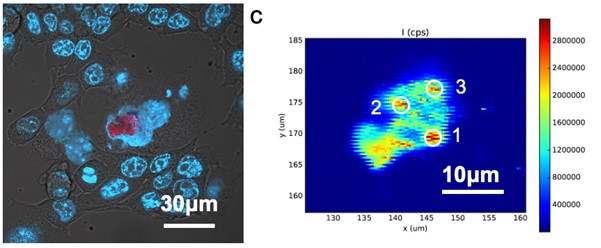
Absolute temperature measurement.
(Left) a 3D laser scan of a tissue sample, with MoQN stained in red. (Right) The ODMR recording in false color. ©2026 Yanai et al. CC-BY-ND
Journal article:
Hitoshi Ishiwata, Jiarui Song, Yoko Shigeno, Koki Nishimura, and Nobuhiro Yanai. 2026. Molecular Quantum Nanosensors Functioning in Living Cells. Science Advances. DOI: 10.1126/sciadv.aeb5422