


DATE2026.04.03 #Press Releases
New Developments in High-Energy-Resolution X-ray Absorption Spectroscopy Led by Superconductivity Technology
Disclaimer: machine translated by DeepL which may contain errors.
Multifaceted Precise Speciation: The Case of Cesium
Summary
Dr. Eiko Yamaguchi, Deputy Director of the Center for Computational Science & e-Systems, Japan Atomic Energy Agency (and Visiting Researcher, Graduate School of Science, The University of Tokyo), Dr. Masahiko Okumura, Director of the Center for Computational Science & e-Systems, Dr. Shinya Yamada, Associate Professor, Graduate School of Science, Rikkyo University, Dr. Sunao Hashimoto, ECL Research Team Leader, RIKEN, RIKEN Nishina Center for Accelerator-based Science and Technology (and The research group, which includes Associate Professor Takuma Okumura of the Graduate School of Science, The University of Tokyo, and Professor Yoshio Takahashi of the Graduate School of Science, The University of Tokyo (and Director of the Isotope Science Center, The University of Tokyo), has analyzed fluorescent X-rays using the superconducting transition edge detector (TES) with a high energy resolution measurement, and has found that the energy of cesium is a key component in the formation of the superconducting transition edge in the Cesium-ion (Cs). The research group led by Dr. Y. Kurokawa and Dr. Y. Kurokawa, Director of the Center for Isotope Science and Technology at the University of Tokyo, has successfully improved the energy resolution of cesium (Cs) X-ray absorption spectra by analyzing high-energy-resolution X-ray fluorescence using a superconducting transition edge detector (hereinafter referred to as TES) (). This method has revealed that more detailed estimation of the chemical state of Cs is possible.
TES can detect X-rays over a wide energy range with high energy resolution at a time, and thus can obtain three-dimensional data with high resolution in a single measurement. We have shown that the chemical state of Cs can be analyzed in detail by analyzing this data from various angles and obtaining X-ray absorption near edge structure (XANES) spectra and resonant inelastic X-ray scattering (RIXS) maps. These measurements using TES have been limited to the soft X-ray region below 2 keV. This is the first time in the world that these measurements using TES have been applied to the 4-5 keV region. This technique can be applied to various elements, not only Cs, and is expected to enable detailed speciation of trace elements that have been difficult to measure in the past.
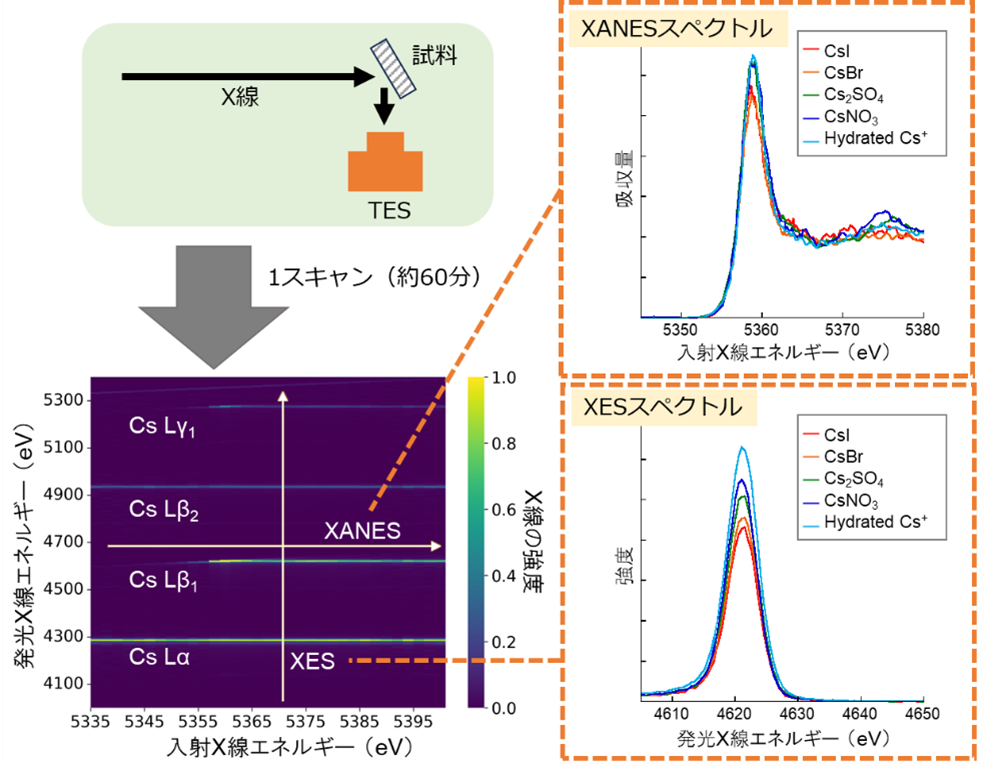
Conceptual diagram of measurement using TES and three-dimensional data obtained in a single measurement
Links
Japan Atomic Agency, Rikkyo University, RIKEN, Tokyo Metropolitan University
Publication Information
-
Journal name Journal of Synchrotron Radiation Title of paper Simultaneous measurements of HERFD-XANES, RXES, and RIXS of Cesium Using a Transition-Edge SensorAuthor(s) Akiko Yamaguchi*, Shinya Yamada, Tadashi Hashimoto, Takuma Okumura, Yasuo Takeichi, Masahiko Okumura, Yoshio Takahashi DOI 10.1107/s1600577526001682