


DATE2026.04.04 #Press Releases
Elucidating the Mystery of Structural Fluctuations Hidden in Polar Metals
Disclaimer: machine translated by DeepL which may contain errors.
Shallow Potential and New Dynamics Generated by Conduction Electrons
Summary
Metals and polarity (electrical polarization) have long been considered incompatible properties in physics. This is because conduction electrons moving freely in a metal cancel out the electrical polarization inside the material (shielding effect). This common sense has been overturned by the recent discovery of "polar metals. However, the essential mechanism of how conduction electrons affect the stability of polar structures and the dynamics of phase transitions remained unresolved.
An international research group led by Kantaro Murayama, a Doctoral student at the Graduate School of Engineering, Kyoto University, Associate Professor Hiroshi Takatsu, Professor Hiroshi Kageyama, and Professor Ryotaro Arita at the Graduate School of Science, The University of Tokyo, has demonstrated that a phase transition occurs between polar and non-polar structures in lithium rhenium oxide ( LiReO3 ), which exhibits metallic electrical conductivity. Furthermore, it was revealed that the structure is not statically fixed but structural fluctuations persist even in the low-temperature region below the transition temperature ( Ts ).
In this study, we clarified that conduction electrons form a "shallow potential" that makes the energy difference between polar and non-polar structures extremely small. As a result, we have shown that dynamic fluctuations exist even below Ts, and peculiar physical properties such as hysteresis phenomena over a wide temperature range and reverberant resonant absorption for ultrasonic waves appear.
This achievement redefines "fluctuation," which was previously regarded as noise to be eliminated, as an essential physical phenomenon originating from shallow potentials. It presents a new material design guideline based on the competition between polarity and metallic conduction, and is expected to be applied to environmental power generation and energy-saving devices.
The results will be published online in the international journal Science Advances on April 3, 2026 (2 p.m. EST).
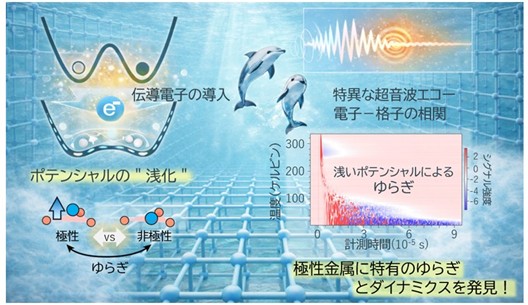 Figure: Created by Hiroshi Takatsu, ChatGPT 5.3
Related Link
Published Journals
| Journal name |
Science Advances
|
|---|---|
| Title of paper |
Lattice softening and diffusive dynamics in the polar metal LiReO3 |