
DATE2025.10.03 #Press Releases
Development of a Candidate Therapeutic Agent for Fatal Severe Drug Eruptions
-Discovery of an inhibitor that suppresses disease-specific cell death and demonstration of its efficacy in preclinical studies-
Summary
A collaborative research group including Haruna Kimura (doctoral student, Graduate School of Medical and Dental Sciences, Niigata University), Akito Hasegawa (Assistant Professor, Department of Dermatology, Niigata University Medical and Dental Hospital), Professor Riichiro Abe (Department of Dermatology, Graduate School of Medical and Dental Sciences, Niigata University), Professor Takeaki Ozawa (Analytical Chemistry Laboratory, Department of Chemistry, Graduate School of Science, The University of Tokyo), and Lecturer Youichi Ogawa (Department of Dermatology, Faculty of Medicine, Graduate School of Interdisciplinary Research, University of Yamanashi), has developed a novel therapeutic agent with the potential to improve prognosis in severe drug-induced skin reactions, namely Stevens–Johnson syndrome (SJS) and toxic epidermal necrolysis (TEN).
SJS/TEN are life-threatening diseases with a mortality rate of up to 30%. The research group previously revealed that necroptosis, a form of programmed cell death mediated by formyl peptide receptor 1, occurs in the affected skin lesions. In this study, the group developed an inhibitor of necroptosis, which successfully suppressed cell death in SJS/TEN model cells and prevented disease onset in a mouse model.
These findings were published in Nature Communications on September 30, 2025.
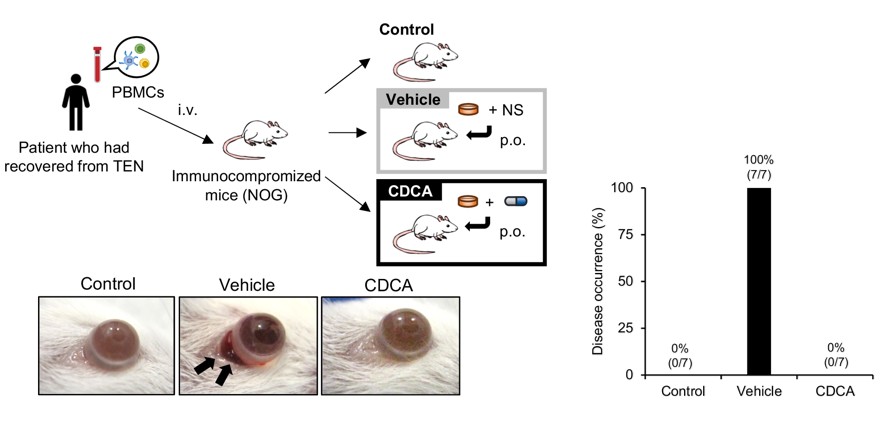
Figure:Administration of CDCA in an SJS/TEN mouse model. Mice administered only the causative drug of TEN patients showed SJS/TEN-like conjunctivitis, whereas administration of CDCA suppressed the onset of conjunctivitis.
Links
Niigata University, University of Yamanashi
Journals
-
Journal name Nature CommunicationsTitle of paper