


DATE2025.05.22 #Press Releases
A fierce storm in a giant barred spiral galaxy 11 billion years ago
Summary of Presentation
ALMA has obtained detailed images of the gas distribution and motion in the barred spiral structure of a monster galaxy. The results reveal that this galaxy, which existed in the early universe, looks very similar to barred spiral galaxies in the present-day universe, but the gas within its barred structure is blowing violently and causing intense star formation. This is an important research result that adds new knowledge to the history of galaxy growth and evolution.
In the early universe, billions of years after the birth of the universe, there were many monster galaxies that formed stars hundreds of times more rapidly than galaxies in the current universe. Because the dust produced by this intense star formation absorbs visible light, it has been detected by millimeter- and submillimeter-wave observations, which are less affected by the dust.
Monster galaxies have been thought to eventually grow into giant elliptical galaxies. Recently, however, they have also been detected in infrared observations, which are less susceptible to the effects of dust as well as radio waves, and it has become clear that there are many monster galaxies with disk structures. In particular, the James Webb Space Telescope (JWST), which boasts high resolution, has been capturing images of spiral galaxies with disk structures, among other monster galaxies, one after another. However, JWST has been unable to study the motion of gas within the galaxy in detail, and has not been able to elucidate the mechanism of active star formation.
To investigate star formation in monster galaxies with disks, a team of astronomers from the National Astronomical Observatory of Japan and other institutions focused on a galaxy called J0107a, whose giant barred spiral structure has been observed by JWST. The team used the ALMA telescope to observe radio emissions from interstellar molecules in order to understand the motion of the gas in this galaxy. They found that the distribution and motion of the gas in the barred spiral galaxy is very similar to that of barred spiral galaxies in the present-day universe, but the ratio of gas to stars in the barred structure and the velocity of the gas are different.
The proportion of gas in the barred structure of J0107a is several times greater than that of present-day galaxies, and the gas flow, which is several hundred kilometers per second, is blowing violently within a radius of 20,000 light years, causing some of the gas to fall into the center of the galaxy, resulting in intense star formation. This is thought to be the process of forming barred spiral structures in galaxies in the early universe. This is the first time such a structure or process has been captured observationally and has not been predicted by theory or simulation.
The detailed distribution and motion of the gas obtained from these observations will provide important clues not only to the diverse origins of galaxies, but also to the formation and evolution of the more universal barred structure of galaxies," said Dr. Fan, Project Researcher at the National Astronomical Observatory of Japan, who led the study and is conducting the research at Nagoya University.
The formation and evolution of galaxies have occurred in the context of large scale gas flows. This study suggests a new story in which disk galaxies were born in gas flows that exceeded the galactic scale, then evolved within the galaxy, resulting in the emergence of barred structures, and intense gas flows at the galactic scale that triggered active star formation. To confirm this picture in detail, the research team plans to observe gas flows on even larger scales beyond the galactic scale using the ALMA telescope.
This result was published online in Nature on May 21.
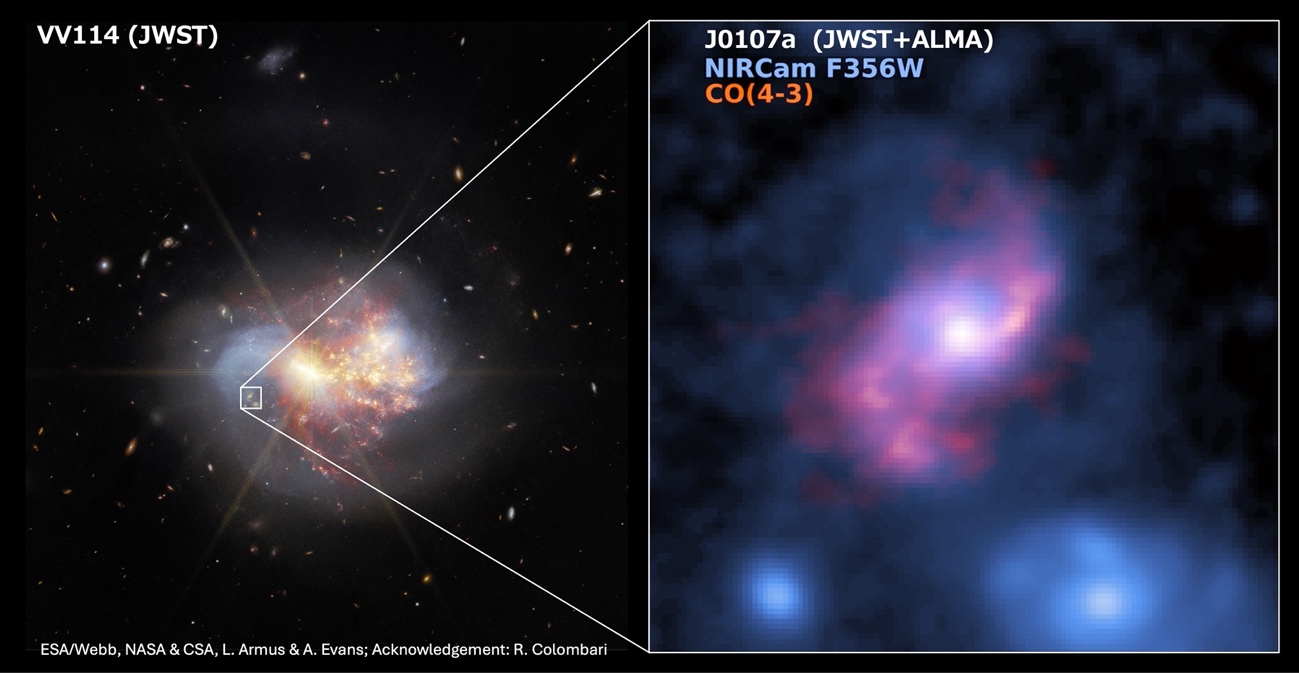 Figure: Near-infrared image of a nearby galaxy VV114 and the background monster barred spiral galaxy J0107a at z=2.467 captured by the James Webb Space Telescope (credit: NASA). Right: Stellar and molecular gas distribution of J0107a (credit: NASA, ALMA(ESO/NAOJ/NRAO), Huang et al.).
Related Links
ALMA Observatory(NAOJ), National Astronomical Observatory of Japan, Nagoya University, Shizuoka University
Published Journals
-
Journal name NatureTitle of paper Large gas inflow driven by a matured galactic bar in the early Universe