


DATE2025.05.12 #Press Releases
Initiation of Fault Rupture in Major Earthquakes
--Understanding How Ductile Deformation of Rocks Leads to Fault Rupture in the Subsurface--
Summary
Norio Shigematsu, Principal Researcher of the Active Fault and Volcano Research Group at the National Institute of Advanced Industrial Science and Technology (AIST), Thomas Yeo, Research Assistant at the time of the study (currently a researcher at the University of Tsukuba), and Keita Kobayashi, Principal Researcher of the Nanostructure Measurement Standard Research Group at AIST, in collaboration with Professor Simon Wallis of the School of Science, The University of Tokyo, Project Researcher Chunjie Zhang of the Earthquake Research Institute, The University of Tokyo, and Professor Kentaro Ujiie of the Faculty of Life and Environmental Sciences, University of Tsukuba, have revealed a case where strong ductile deformation near the hypocenter of an inland major earthquake led to subsurface fault rupture.
Many inland major earthquakes occur at depths around 10 km, where the high temperatures cause rocks to undergo ductile deformation when subjected to stress. In Mie Prefecture, there is a location where fault structures that were once near the hypocenter of past major earthquakes along the Median Tectonic Line, Japan's largest fault, are exposed at the surface. Rocks collected from this location were analyzed to determine the amount of strain corresponding to ductile deformation and the volumetric fraction of microscopic voids. The results showed that the volumetric fraction of microscopic voids increased with the intensity of ductile deformation, and when it exceeded 7.5%, fault rupture occurred along the subsurface fault.
These findings illustrate an example where the development of microscopic voids due to ductile deformation led to fault rupture in areas where many inland major earthquakes occur. In metals, where microscopic void development due to ductile deformation also leads to rupture, understanding the state of void development allows for predictive assessment of failure. Therefore, this newly acquired knowledge is expected to contribute to the realization of short-term predictive technologies based on information near the hypocenters of major earthquakes.
The details of this research achievement were published in Journal of Geophysical Research: Solid Earth on May 6, 2025.
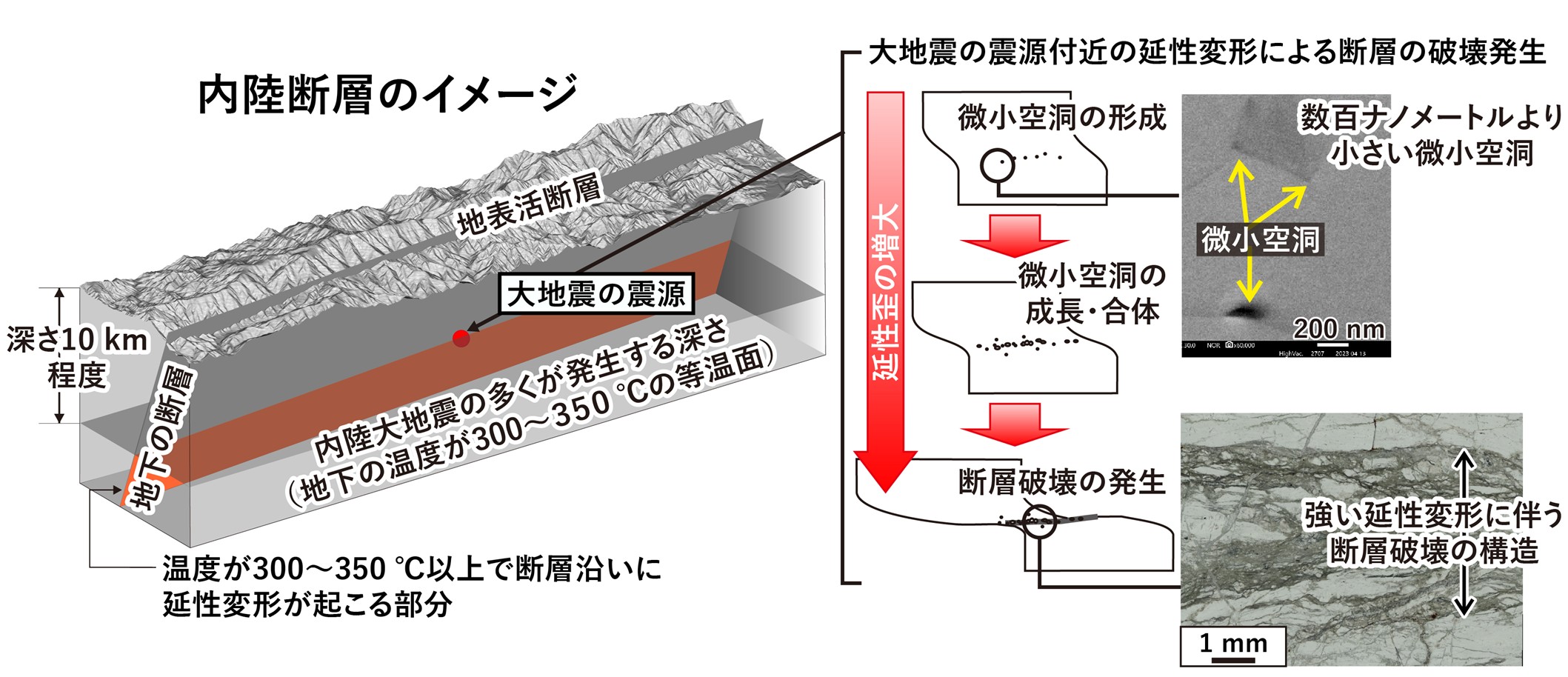 Figure: (Left) Conceptual image of an inland fault. Analysis of rocks from areas near the hypocenters of past major earthquakes.
(Right) Conceptual diagram of the process by which ductile deformation causes fault rupture. The minimum size of the microscopic voids that trigger rupture is less than a few hundred nanometers.
Links
National Institute of Advanced Industrial Science and Technology (AIST), University of Tsukuba
Journal
-
Journal Name Journal of Geophysical Research: Solid EarthTitle of paper