![リガクル[RIGAKU-RU] Exploring Science](/ja/rigakuru/images/top/title_RIGAKURU.png)





Big skies and big questions
When I was a child, my parents often took me camping. We would go during the summer break or around Golden Week, sometimes as many as five times a year. We traveled around the Kanto (East Japan) area, including famous places such as Lake Kawaguchi near Mount Fuji in Yamanashi Prefecture or Nasu in Tochigi Prefecture. My favorite was Chichibu in Saitama Prefecture, which we visited every year. While camping, we had numerous opportunities to watch the night sky, warming up next to a campfire. Gradually, I developed a fascination with the night sky and the stars from an early age.
Around the time I entered high school, my interest deepened into more philosophical questions the sky entailed. How big is the universe? Are we alone in it? I was also struck by the fact that the light we see from stars is actually light from the past, sometimes traveling for thousands of years before reaching us.
Despite this, I had not decided to major in astronomy when I entered college. During my first and second years, I actively took any lectures that interested me, not only in astronomy but also in a wide range of fields such as neuroscience, education, gender studies, and medicine. However, the Department of Astronomy was unique in that students and professors could interact often and freely, thanks to the small size of the department. Moreover, I felt like my senior project was just the start of my research. So, I decided to continue my studies in graduate school.

Rare AKARI data
AKARI is a Japanese astronomical satellite launched in 2006. One of its instruments, the Infrared Camera (IRC), observed light from near- to mid-infrared wavelengths. Among its observing modes, LG2 data cover the mid-infrared region, which is a little longer than visible light.
Using this LG2 data, I study the diffuse Galactic emission: the component of starlight in the Galaxy that is scattered by tiny dust particles floating between stars. These data are rare for two main reasons. First, the observations are about the interstellar space itself rather than specific astronomical objects such as stars, allowing us to investigate the characteristics of interstellar dust directly. Second, they include mid-infrared wavelengths around 20 microns (one micron is one millionth of a meter). This is rare because this wavelength region is affected by strong absorption and scattering by atmospheric molecules, making ground-based observations incredibly difficult. Even with space telescopes, systematic observations of the diffuse Galactic emission around 20 microns have been limited.
Reviving data unused for 20 years
Despite their scientific potential, LG2 data had remained difficult to use for nearly 20 years. This was because the raw data were contaminated by unwanted light caused by the optical structure of the instrument itself. My supervisor suggested that I tackle this problem by developing a reliable data-reduction method as a first step toward scientific analysis. The project piqued my interest as it was my chance to work with data that no one had analyzed before.
The main challenge was distinguishing real astronomical signals from instrumental effects. LG2 data suffered from artifacts such as contamination of light entering through the edge regions of the mask, as well as scattered light produced by the incident beam within the field of view. To address this, I investigated various parameters such as the geometry of the mask and slit properties, and then modeled the light leakage patterns. Through these analyses, I developed a reliable data-reduction method that eliminates previously uncorrected artifacts and enables accurate extraction of LG2 spectra.
Making full use of the data
After establishing the data-reduction method in such a way, I could go on to analyze diffuse dust emission across the Galactic plane, the region of the Milky Way that contains most of its stars and dust. Analyzing the light coming from each direction, I am trying to clarify the characteristics of dust in both the inner and outer regions of the Galaxy. To my knowledge, this is the first time to systematically analyze the diffuse Galactic emission around 20 microns. I believe it is important to make full use of valuable observational data rather than leaving them unused.
I am currently writing a paper to submit for peer review and publication. I feel like I did my part to honor the scientific legacy of AKARI and can focus my attention on new research projects from now on. I have been thinking about the big questions that the night sky inspired in me when I was a child. Are we alone in the universe? What is the origin of life? To put it in more scientific terms: Where does organic matter that eventually becomes part of living organisms come from?
To answer these questions, I take a two-pronged approach. In laboratory experiments, I aim to reproduce the environment in which organic dust could be created around a star during its final phase of life, called a nova. Additionally, in the future, I plan to observe the actual environment of novae to study how dust is created in space. By combining laboratory work with astronomical observations, I hope to better understand the characteristics of organic dust that is formed around novae, and ultimately, how it is connected to life as we know it.
Christmas in Canada
I have always been interested in what a researcher’s daily life looks like and how research is conducted overseas. I also wanted to place myself in an environment where I would be surrounded by people who did not speak Japanese, in order to improve my English-speaking skills. Thanks to UGRASP (Undergraduate Research Abroad in Science Program), I had the opportunity to spend two weeks at University of Western Ontario in Canada. Although I was an undergraduate student, I spent much of my time talking with graduate students, who taught me a lot about their research. My supervisor also involved me in some projects and entrusted me with a few assignments.
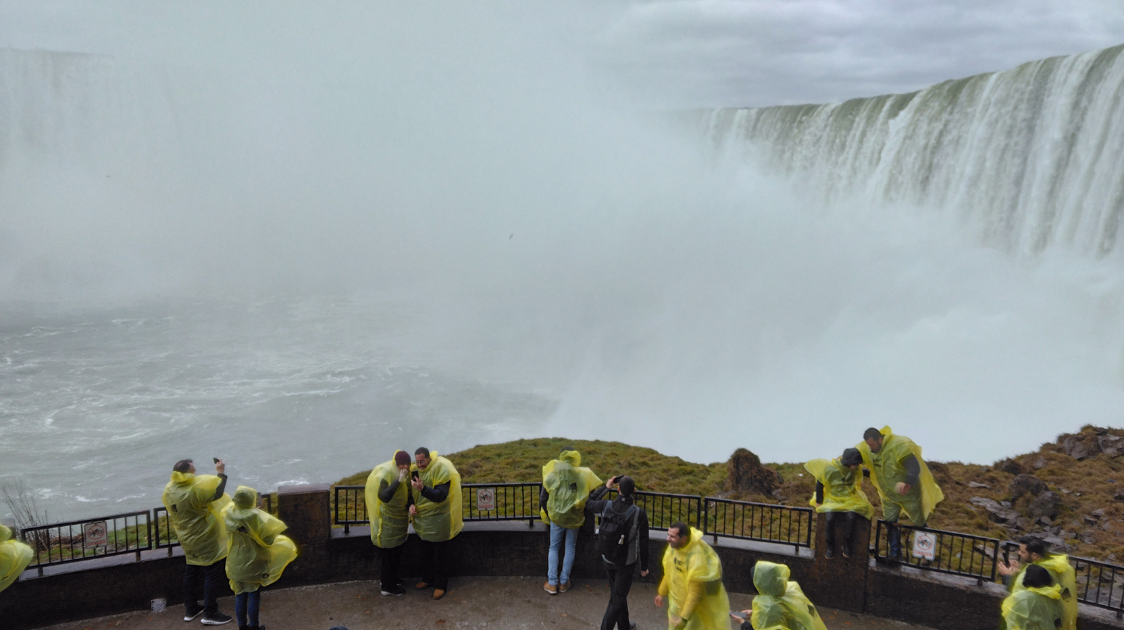
I was surprised to see researchers there communicate with their students more casually, chatting not only about their research or studies, but also about their hobbies or other, more private matters. I also happened to be there during the Christmas season and was, again, quite surprised to see researchers wearing Christmas costumes at a party. It also stood out to me that researchers and students frequently interacted across different labs and departments. This was in contrast to my experience in Japan.
As a result, I had plenty of opportunities to practice speaking English. At first, I found it very frustrating that I could not respond well to my supervisor, even when I understood what she was saying. Each night, I looked up the expressions I wanted to use and wrote them down in a notebook, and from the following days onward, I made a conscious effort to use them in conversations. This practice helped me tremendously, and I gradually gained more confidence in communicating in English.
Science is not just for math lovers
I have received tremendous support over the years, not just in terms of traveling and studying abroad but also in making important academic decisions. As a freshman, I had a wide range of interests and struggled to decide which field to pursue in university. I was particularly uncertain about majoring in astronomy, because I was worried it might limit my job prospects, and to be honest, I was not very good at math.
I still clearly remember the advice I got from my high school teacher, who encouraged me to choose astronomy as a major. He emphasized how it was rare for a college in Japan to have a dedicated department for astronomy. In fact, the University of Tokyo has connections with many observatories and research institutes, which can offer unique opportunities that are difficult to access elsewhere.
Looking back, I am glad that I took that leap of faith. Astronomy is a field that grapples with some of humanity’s biggest questions, and I have found it deeply fulfilling. I have also made another, reassuring discovery: science is not restricted to those who love math. I did not like math in high school, which made me a little hesitant to major in astronomy. However, thus far, I have been enjoying using math as a powerful tool to explore and understand fascinating phenomena.



Related articles